As everyone knows, a rational number is a number x that can be written as a fraction x = a/b, where a is an integer (positive, negative, or zero) and b is a nonzero natural number. Thus, 1.25 = 5/4 and 1/3 = 0.333… are rational numbers.
Ancient mathematicians had already discovered the existence of irrational numbers—which do not belong to the set of rational numbers, denoted by ℚ—via some very simple geometric figures.
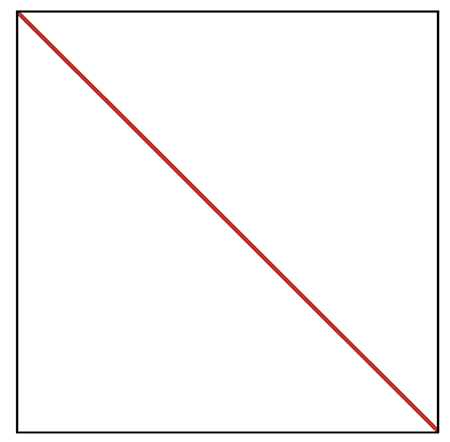
The Pythagorean theorem tells us, for example, that the length of the diagonal of a square with side length 1 is a number x satisfying the equation *x 2 = 12 + 12 = 2. Yet arithmetic arguments well within the reach of a high-school student show that the unique positive number x satisfying this equation (namely the square root of 2) cannot be written in the form a/b, with a and b integers; in other words, it cannot be rational. More generally, whenever a natural number y is not a perfect square (that is, the square of an integer), is irrational.
A long-running quest
-----------------------