



Algebra
Explore mathematics articles on the theme of algebra.
 Podcast
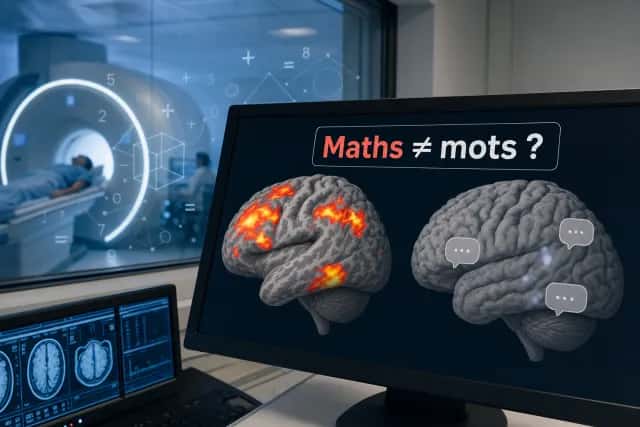
Do you think in words when solving an equation?
Neuroscience reveals that the brain processes mathematics through networks distinct from those of natural language, calling into question our understanding of mathematical cognition.
 Podcast
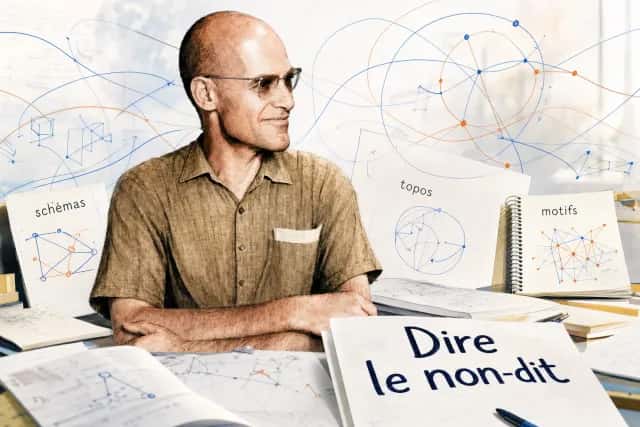
Alexandre Grothendieck: the quest for mathematical language
A portrait of Grothendieck, a mathematical genius whose practice was intimately bound up with an aesthetics of language, from schemes to topoi.
 Podcast
CubeHarmonic: the Rubik's Cube that makes algebra audible
Invented by Maria Mannone, the CubeHarmonic uses a Rubik's Cube to create musical harmonies and teach algebra intuitively.
 Podcast
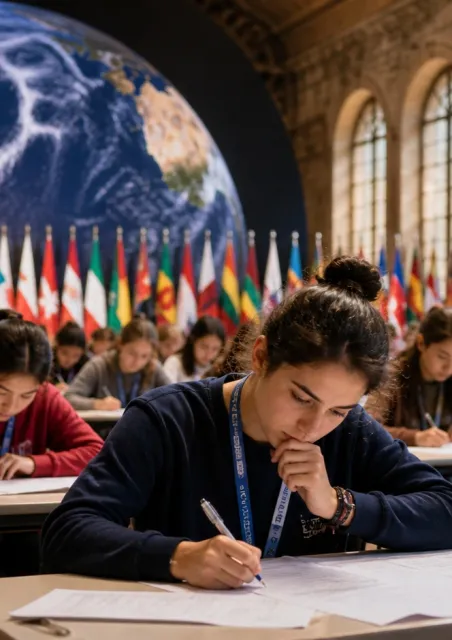
EGMO 2026 Bordeaux: 260 girls shake up math
The European Girls' Mathematical Olympiad brought together 260 participants from around the world in Bordeaux for the 15th edition of this competition dedicated to promoting girls in mathematics.
 Podcast
Integer points on a line: methods of solution
Many problems in discrete geometry are simply stated and can be used in teaching to make certain concepts easier to understand. Searching for points with integer coordinates on a line naturally leads to applications of theorems from number theory.
 Podcast
Moving on the discrete plane: generating sets and minimality
Exploring how one can move around a grid leads to the concepts of generating sets and minimality. This example shows the power of discrete geometry as a tool for better visualizing and exploring complex ideas from classical geometry or algebra.

Patrice Jeener: the mathematical engraver who turned equations into art
Patrice Jeener (1944–2026) passed away on March 3 in his village of La Motte-Chalancon, in the Drôme.
 Podcast
Theaetetus and the diagonal: why stop at √17?
How should we understand the famous passage in the Theaetetus where Theodorus mysteriously stops at the square root of 17? A new hypothesis emerges, involving continued fractions and triangular numbers.
 Podcast
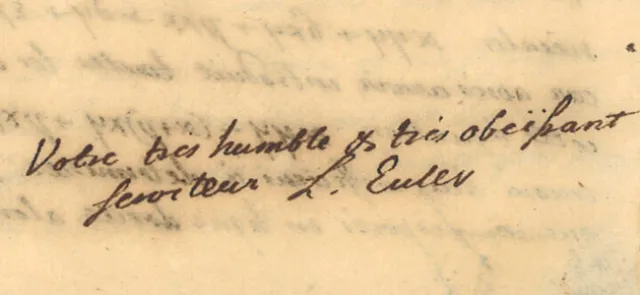
Euler–Cramer paradox: Are 9 points enough to define a cubic?
The Euler–Cramer paradox: If nine points seem sufficient to determine a cubic curve, how can two distinct cubics also pass through those same nine points?
 Podcast
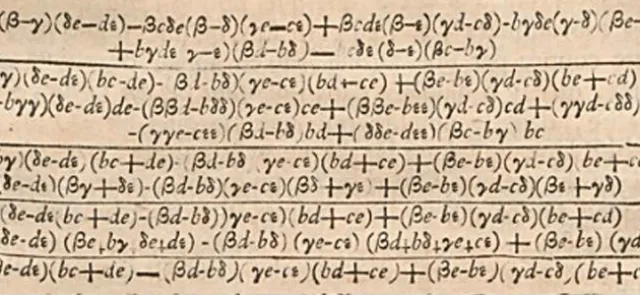
Gabriel Cramer and Cramer's rule in the 18th century
The appendix to Gabriel Cramer's Introduction à l’analyse des lignes courbes algébriques contains the famous rule for solving systems of linear equations and Bézout's theorem.
 Podcast
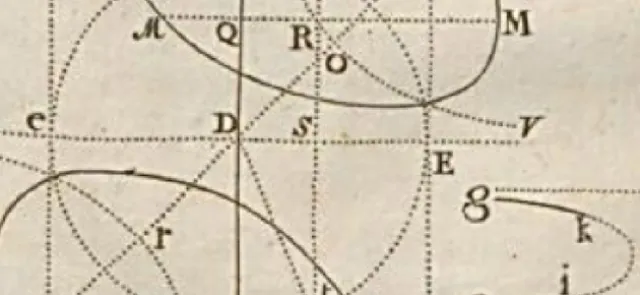
Plotting algebraic curves in the 18th century: Newton’s and Cramer’s analytic methods
How did Gabriel Cramer plot algebraic curves in 1750? Discover Newton's analytical parallelogram and Cramer's analytical triangle.
 Podcast
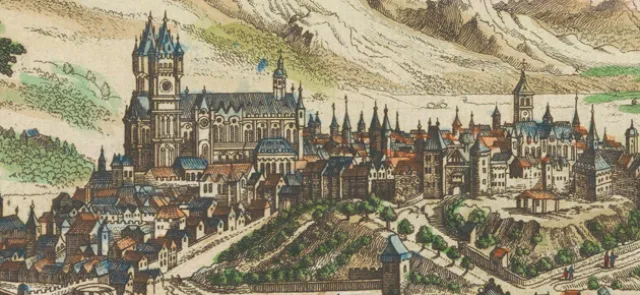
Gabriel Cramer: the journey of an 18th-century Genevan mathematician
Explore Gabriel Cramer's journey, from his education in Geneva to his European Grand Tour among the leading mathematicians of his day.
Algebra mourns: Jacques Tits has passed away | Tangente
Belgian-born French mathematician Jacques Tits (1930–2021) passed away in early December.

Integer linear programming | Tangente
Solving optimization problems may require formulating them as mathematical models. Integer linear programming does this using only linear polynomials whose variables must take integer values.

Conway and group theory | Tangente
Conway developed a passion for groups—and sporadic groups in particular—at an early age.
Degree 45: François Viète rises to the challenge! | Tangente
Reconstructing a historic mathematical challenge.

Polynomials that make a difference | Tangente
A polynomial can be evaluated without any multiplication, using addition alone. Charles Babbage based his famous "Difference Engine" on this remarkable property.
Pierre Duchet: research in action | Tangente
Mathematician Pierre Duchet died on October 27 last year at his home in Mexico City. A friend of the editorial team at Tangente, this specialist in combinatorics, discrete mathematics and especially graph theory was always eager to share his work with younger generations.
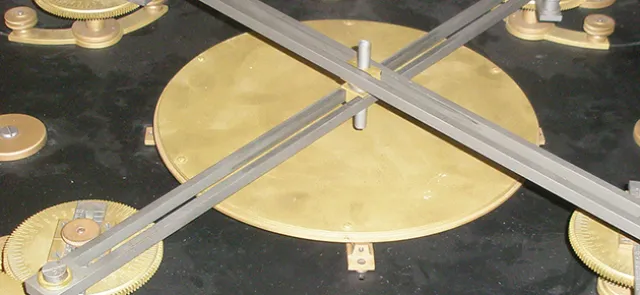
The campylograph | Tangente
At the end of the 19th century, Father Dechevrens, director of the Jersey observatory, devised a curve-drawing machine. Originally designed to plot the paths of the planets as seen from Earth, it could produce many other curves besides epicycles!
Breakthrough Prize awarded to Vincent Lafforgue | Tangente
French mathematician Vincent Lafforgue, brother of 2002 Fields Medalist Laurent Lafforgue, has won the 2019 Breakthrough Prize in Mathematics, worth $3 million, "for his fundamental and elegant contributions to the Langlands program in the function field case."