A week that changes lives
Picture an exam hall where 260 young women from dozens of countries are simultaneously tackling problems that most adults wouldn't even know where to begin with. No calculator, no internet — just a pen, a blank sheet of paper, and a mind racing. That's exactly what happened at the University of Bordeaux on 12 and 13 April 2026, during the 15th edition of the European Girls' Mathematical Olympiad, better known by its acronym EGMO.
An international mathematics competition, fair enough. But EGMO isn't quite like the others. Founded in 2012, it grew out of a simple and slightly unsettling observation: the major international mathematical olympiads, though open to all, see very few girls among their participants. EGMO was created to change that — not by lowering the level, but by offering a space where young women mathematicians can come into their own, meet one another, and take on problems of the highest caliber.
Three problems, four hours, and a whole world
To understand what EGMO represents, you first have to grasp what an olympiad problem actually is. Forget school exercises with a ready-made method. Here, each problem is an original puzzle, carefully crafted by mathematicians from around the world, that can take hours — sometimes days — of thought. The topics range from number theory (the properties of integers, divisors, prime numbers) to geometry, by way of combinatorics (the art of counting complex configurations) and algebra. There's no recipe: you have to find the path yourself.
Each day of competition offers three problems to solve in four and a half hours. The 2026 edition's problems can be viewed on the official website, egmo.org — and if you have an hour to spare and an adventurous spirit, the first problem will give you a good sense of just how demanding it is.
"EGMO isn't just a competition. It's living proof that mathematics has no gender."
Bordeaux as the backdrop, the whole world as the audience
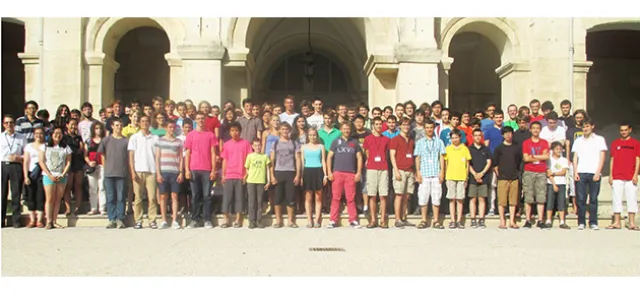
For this 15th edition, it was the city of Bordeaux that opened its doors. Nearly 260 participants from around the world — well beyond Europe's borders, since EGMO also welcomes delegations from Asia, Africa and the Americas — arrived in the capital of the Gironde for a week combining intellectual rigor with human discovery.
From the very first day, the tone is set: delegations meeting one another, volunteers attending to every need, and that particular atmosphere that only great international scientific gatherings can create — a blend of excitement, nervousness and shared curiosity. Young women who, back home, often feel like exceptions suddenly realize there are hundreds of others who share the same passion.
After the exams, life
EGMO isn't just about hours spent hunched over exam papers. The organizers understood this well: once the exams are over, it's time for a program of activities designed to let participants catch their breath, build connections, and discover the region.
On the agenda: a visit to the Bassin des Lumières, an immersive museum housed in former industrial tanks where works of art are projected onto surfaces covering several thousand square meters. A boat trip on the Garonne. Pottery workshops, textile DIY sessions, dance classes, or an introduction to magic. So many reminders that the minds solving Euclidean geometry problems also know how to have fun.
Two excursions left a lasting impression. First destination: Saint-Émilion, the medieval town perched in the heart of the Bordeaux vineyards, with its cobbled streets and its monolithic church carved straight out of the rock. Second destination, and perhaps the most spectacular: the Dune du Pilat. Standing 106 meters high and stretching three kilometers long, it is the tallest dune in Europe — a desert of sand set on the edge of the Atlantic, facing the Landes forest. It's hard to imagine a better antidote to exam stress.
A closing ceremony, medals, and tears
The week closed with a closing ceremony charged with emotion. Medals awarded, thanks given, music playing — and those glances exchanged between participants who know they have just lived through something rare. For many, EGMO represents far more than a line on a résumé: it's often the moment when a calling is confirmed, when a young woman realizes she can make mathematics her career.
The event is run by an association whose mission is explicit: to promote mathematics and equal opportunity. Behind this week lie months of preparation, dozens of volunteers, and the support of institutions, research laboratories, foundations and companies that chose to support this ambition.
And now, Zagreb?
The delegations parted ways with the promise of meeting again. The 16th edition of EGMO will be held in Croatia, from 11 to 17 April 2027. A new city, new problems, new participants — but the same founding idea: mathematics is for everyone, and it's high time the world remembered that.
In the meantime, the Bordeaux problems are already circulating on forums, blogs and discussion groups within the global mathematical community. Somewhere, a high school student who wasn't in Bordeaux downloads them, sits down at her desk, and starts thinking. Maybe she'll be in Zagreb next year.