Seven appearances. Five gold medals. Two silver medals. And to top it off, the perfect score. Add it all up, and you get something nobody had achieved in sixty-seven years of International Mathematical Olympiads.
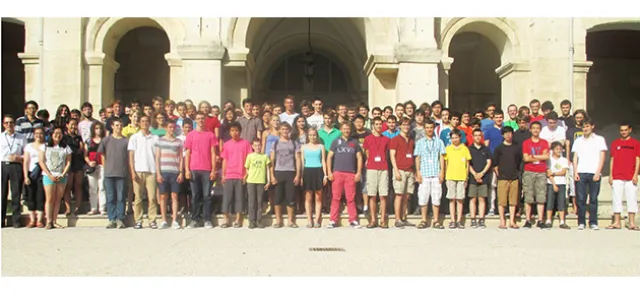
The 67th edition of the IMO was held in Shanghai from 10 to 20 July 2026, bringing together 666 candidates from 117 countries. Among them was a 17-year-old British high schooler at Tonbridge School in Kent: Alex Chui. As Vietnam.vn reports, he came away with a score of 42 out of 42 — seven points out of seven on each of the six problems — and a record that experts in the field consider likely to stand for decades.
Seven times at the starting line
To grasp the scale of the record, we need to go back to 2020. Alex Chui was then 12 years and 156 days old — one of the youngest competitors in the history of the competition — and he was representing Hong Kong. Two silver medals later, he switched to British colours from 2022, strung together gold medals in 2021, 2023, 2024 and 2025, and closed out his Olympiad career in 2026 with this perfect score, according to the results published in the official IMO individual rankings.
Seven medals in seven appearances. It is this total that makes the record absolute: before him, no candidate had ever amassed so many distinctions in this competition.
A perfect score in an exceptional edition
One clarification is needed here. Alex Chui was not the only one to score 42/42 in Shanghai. Seven candidates out of 666 reached the maximum score: Leyan Deng, Che Liu and Bolun Zhang for China, Hyeonjun Lee for South Korea, Liam Reddy and Alexander Wang for the United States — and Alex Chui for the United Kingdom, according to official IMO data. In other words, about 1% of participants achieved perfection. That is rare. But it also means the 2026 edition was exceptionally crowded at the top, as confirmed by the Mathematical Association of America, which notes that the United States finished second in the team event behind China.
The gold medal threshold was set at 29 points out of 42. This means a candidate who can correctly solve four problems out of six earns gold. Solving all six is another matter entirely.
What the problems really ask for
The IMO consists of six proof-based problems spread over two days, three problems per four-and-a-half-hour session. No numerical computation, no formula to apply: each problem demands a rigorous proof, built from scratch, on a blank page. The six problems of the 2026 edition came from proposals submitted by six different countries — Luxembourg, Ukraine, Russia, Switzerland, Latvia and Taiwan — according to information published by the British team via the UKMT.
Take problem 1: it concerns repeated operations involving the greatest common divisor (gcd) and the least common multiple (lcm) of two integers. For anyone who sees an integer as a stack of prime powers — 12 = 2² × 3, for instance — the gcd/lcm operation amounts to redistributing these exponents between two stacks. The gcd takes the shared levels, the lcm gathers all the available levels. What mathematicians call an invariant — a quantity that does not change through the operations — then makes it possible to prove both that the process stops and that the final result does not depend on the order of the steps, as explained by a guide to olympiad techniques widely used in competition preparation.
Problem 5, meanwhile, asks for all functions satisfying a double inequality between a quadratic mean, an arithmetic mean and a geometric mean. The challenge is not to compute but to understand when these three means coincide — and to show that this coincidence forces the function into a single form. This is what olympiad competitors call exploiting equality cases: if an expression is trapped between two bounds that touch at only one point, it has no choice.
This is what the IMO tests: not speed of computation, but the ability to find the idea that suddenly makes the problem transparent. Repeating that feat six times in a row, within a limited time, without a single error — that is what Alex Chui achieved in Shanghai.
What comes next: Cambridge, and life after competition
Alex Chui said, according to VnExpress International, that the most exciting part of the IMO remains meeting students from around the world, united by the same passion for mathematics. He is announced as a future student at Cambridge. The closing ceremony was held on 20 July 2026 at Shanghai High School, and the official IMO press release already announces the next edition: Budapest, in 2027.
Key concepts
The hidden mechanics behind a perfect score: invariants, pigeonholes and inequalities
A perfect score at the IMO cannot be explained by mastery of a catalogue of formulas. It requires recognising, in each problem, the underlying mathematical structure — often a simple idea applied with precision. Here are three tools that illustrate this logic.
Invariants and monovariants. An invariant is a quantity that remains unchanged when a repeated operation is applied to a mathematical object. A monovariant, by contrast, is a quantity that always moves in the same direction (always increasing, or always decreasing) without being able to do so indefinitely. These two tools serve two distinct purposes: proving that a process stops (thanks to the monovariant), and proving that the final result is unique regardless of the sequence of operations chosen (thanks to the invariant). Problem 1 of IMO 2026 combines exactly these two dimensions.
The pigeonhole principle. Formalised in the 19th century as the Dirichlet box principle, it states that if n + 1 objects are distributed into n boxes, at least one box contains two objects. In its generalised form, it guarantees that at least one box receives ⌈(n+1)/n⌉ objects. This principle is one of the most economical tools in mathematics: from an elementary count, it forces the existence of a collision without needing to construct it explicitly.
Inequalities between means. The AM-GM inequality states that the arithmetic mean of positive numbers is always greater than or equal to their geometric mean, with equality if and only if all the numbers are equal. Combined with the Cauchy-Schwarz inequality, it makes it possible to sandwich complex algebraic expressions between two bounds. The olympiad interest lies precisely in the equality cases: if an expression is trapped between two bounds that coincide at a single point, the function being sought is entirely determined. This is the mechanism behind problem 5 of IMO 2026, where a double constraint between the quadratic, arithmetic and geometric means forces the solution into a single form.
These three tools share the same aesthetic: a minimal idea that produces a maximal conclusion.