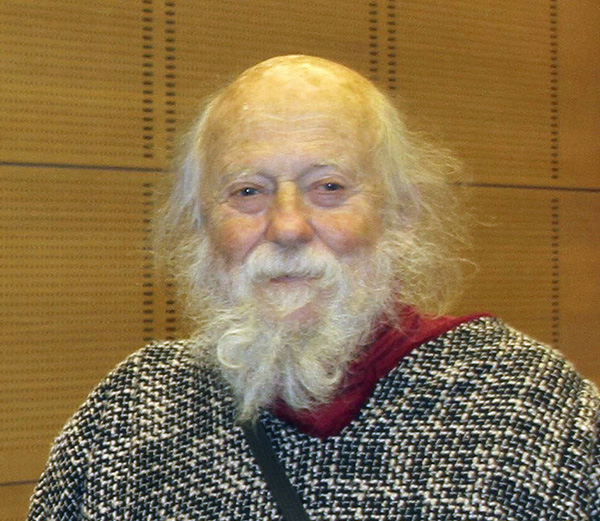
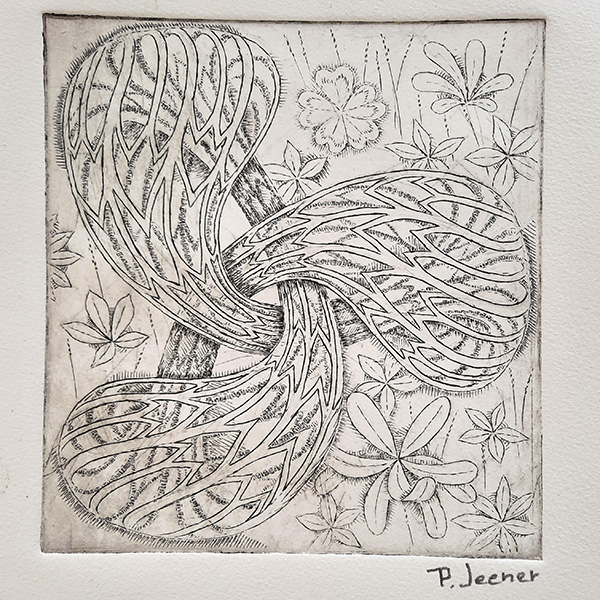
Anyone interested in popular mathematics and mathematical art may well have come across this intriguing figure, recognizable by his long white beard and flowing cape. Patrice Jeener, an engraver whose favorite subjects were geometry and curves, taught himself mathematics. In 1963, he enrolled at the École supérieure des beaux-arts, where he learned engraving. His fascination with mathematics, particularly the representation of algebraic equations, began after a visit to the Palais de la découverte, where part of the Institut Henri-Poincaré's collection of plaster surface models was on display. He then immersed himself in the study of algebraic curves and taught himself to program in BASIC. The resulting surface plots were printed on tracing paper so that they could then be engraved on copper plates, first using drypoint and later with a graver. The plate was then inked and printed on paper using an intaglio press.
Patrice Jeener in 2019.
Patrice Jeener also explored topology, minimal surfaces, fractals and other polytopes, developing a visceral relationship with these theoretical objects. Many of his drawings of mathematical objects also feature bodies that seem to float in space, along with trees and fantastical plants, creating a dreamlike world that seems to materialize through his copper plates.
Reference: Graveur d’équations. L Hernioux and Gaëlle Octavia, Mathématiques et art plastique, Bibliothèque Tangente no. 23, POLE, 2019.
A dialogue between art and mathematics
--------------------------------------------
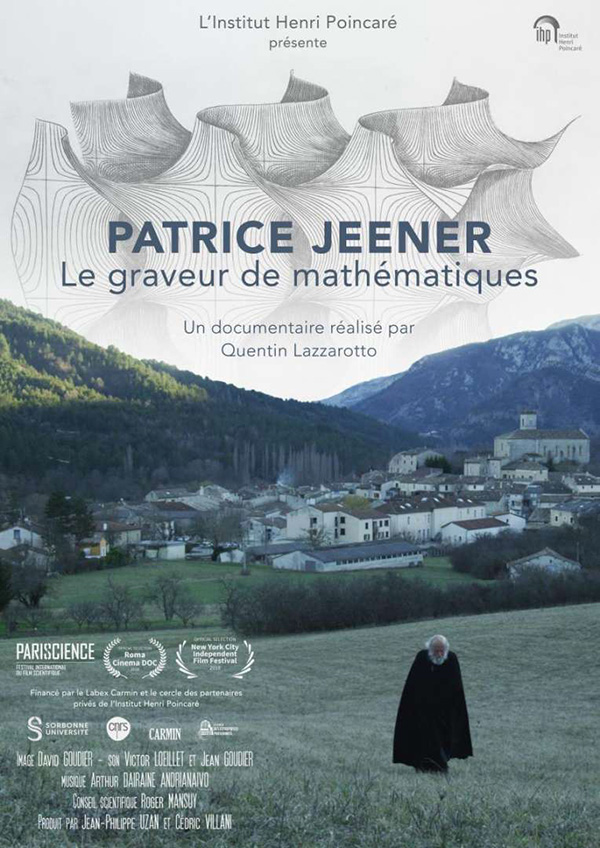
In the 2016 documentary Graveur de mathématiques, directed by Quentin Lazzaroto, Patrice Jeener opens the doors to his world, both literally and figuratively. First, to his home in La Motte-Chalancon, where he set up his studio. We see him at work there, graver in hand, bent over a copper plate. He describes the stages involved in producing his fascinating drawings. Then he opens the door to his inner world, which intrigues his family and friends. His research began with art. He shows us his library of books on curves and equations, which he studies regularly in an effort to "understand how it works". He explains that, when he engraves abstract objects, it is "as though [he] were entering another world, where [he wanders]" and where he would have liked to live. His life as a hermit is devoted entirely to engraving, which is "an extension of himself", as relatives astonished by the depth of his passion attest.
Biographical scenes focusing on the artist are juxtaposed with interviews with mathematicians (women among them!) who explain how they see mathematics and share their feelings about the engravings. This delightful hall-of-mirrors effect once again brings together two worlds: cinema and mathematics.
Two publications
-----------------
A meeting with André Deledicq led to two publications devoted to his work: "Patrice came to see me when I was director of the IREM de Paris, in the early 1980s, to show me the mathematical engravings he had already been making for almost 20 years. For me, it was a discovery almost as significant as my discovery of the sculptor Raoul Raba at around the same time: I decided then to help him and never stopped throughout his life of poverty and hardship."
• Espaces gravés. Patrice Jeener, Cedic-Nathan, 1996.
• Graveur mathématique. Patrice Jeener, Éditions du Kangourou, 2018.