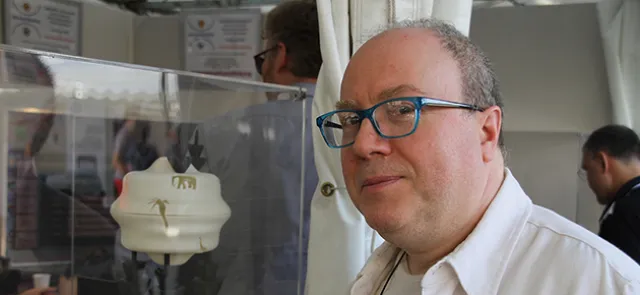
With his science-track baccalauréat in hand, Ulysse Lacoste hesitated between scientific studies and an artistic career. A preparatory course in applied arts enabled him to enter the École Olivier-de-Serres, where he discovered the metal sculpture workshop. There he learned to make metal objects, creating templates from which to construct them in three dimensions. He was introduced to sheet-metal fabrication, which involves cutting developable surfaces that can then be deformed if desired. Basic geometry allowed him to create conical or cylindrical objects, while stretching the metal produced new curves. In his view, this elementary geometry is a tool that simplifies his work and leads to a different way of thinking. Deeply attuned to the materials he uses, he finds metal indispensable. Great metal monuments—the Eiffel Tower being the most iconic among them—stir a powerful emotion in him, prompted by the sheer mass of metal in their structures. As he himself explains: "Metal is very important to me because of its substance, color and history; each metal carries its own imagery. Bronze is warm, noble and sensual; brass is associated with scientific objects—it is the metal of rigor; steel speaks of construction and large-scale structures; copper evokes malleability and conductivity."
Poetic works
============================================================================================================
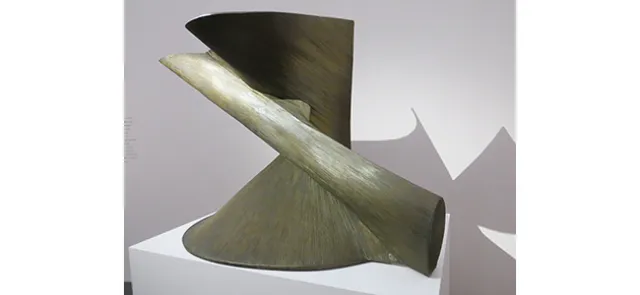
Ulysse Lacoste's latest exhibition at the Galerie Empreintes in Paris was entitled "Mathematical Models / Poetic Modules." The title immediately captures the artist's approach. Asked whether the mathematical models at the Institut Henri-Poincaré inspired him, he says they did, but qualifies his answer by pointing out that the objects he creates are not really mathematical models! The artist imagines forms that, a priori, have no particular connection with mathematics. He sketches and refines them, makes templates, envisions them in motion and gradually finds himself thinking geometrically in three dimensions, aiming for simplicity and purity. He realizes that mathematics helps him and is even essential. Yet these objects, born entirely of his imagination, are not initially conceived as mathematical models, even though he acknowledges that he draws inspiration from scientific forms, whether curves, rhythms or forms found in nature. When he rejects the idea that he creates mathematical forms, it is hard not to see a kind of analogy between Ulysse Lacoste and Antoine Pevsner, who likewise refused to regard his sculptures as mathematical objects. This distant kinship is evident in the work Génératrices.
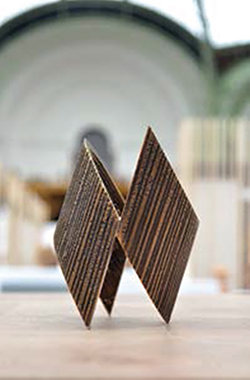
Ulysse Lacoste proudly asserts the poetic nature of his works: they are objects that invite us to dream, that can be handled and viewed at different scales. It is important to feel the material and its temperature, to experience its mass—to engage with it in more than purely visual terms. As he puts it: "My objects have a name, a weight and a scale; they are sculptures. I choose aesthetics and poetry over a beautiful equation." When he invites us to weigh one of his small sculptures in our hands, its sense of mass comes as a surprise; when he sets them rolling, their movements and trajectories are mesmerizing. The work comes alive: it is no longer an inert object behind glass. He first makes these sculptures on a small scale, placing tiny figures beside them to suggest their size. He then reproduces them at human scale so that circus performers, merging physically with the forms, can set them rolling.