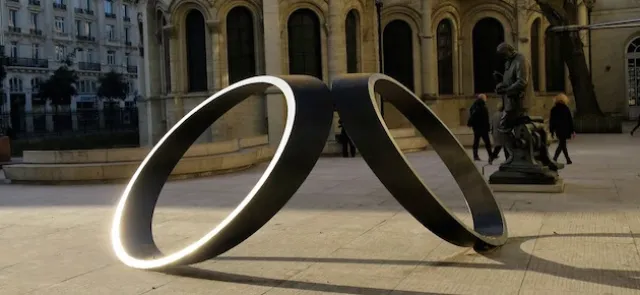
Maurits Cornelis Escher (1898–1972) depicted it masterfully, with his ants tirelessly traversing its single side, while several sculptors have used it to create monumental works. At the museum in Stavanger, Norway, bronze sculptures by Norwegian artist Aase Texmon Rygh (1925–2019) are on display. Japanese sculptor Keizo Ushio (born 1951) has carved several Möbius strips from granite; they can be found across the globe. Swiss artist Max Bill (1908–1994) paid a stirring tribute to it with his monumental granite sculptures, producing some twenty versions.
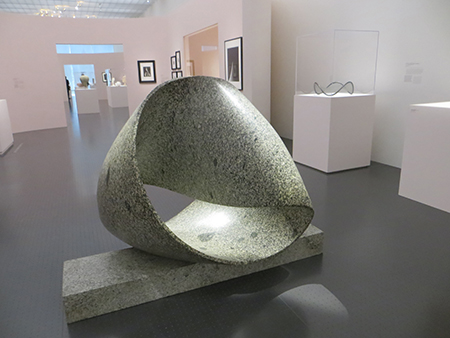
Ruban sans fin (Endless Ribbon), version IV. Max Bill, 1960–1961, gray Wassen granite.
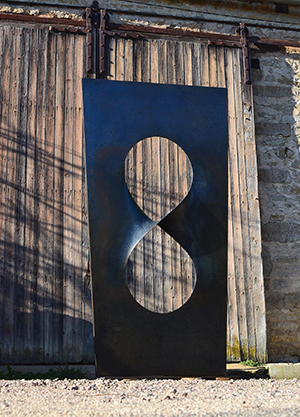
Ulysse Lacoste (born 1981), meanwhile, works primarily in geometric metal sculpture. He conceives shapes that, a priori, have no particular connection with mathematics; he draws and refines them, makes templates, visualizes them in motion, and gradually comes to think geometrically in three dimensions. He finds that mathematics helps him—and is essential—even indispensable—in creating his sculptures and studying their stability. He first makes them on a small scale, then envisions them life-size, thus producing monumental sculptures. One of his works, Le Huit (The Figure Eight), created in 2019, bears an uncanny resemblance to the Möbius strip. In a metal plate pierced by two holes, he makes a cut along a line joining two sides, then performs a "twist" that produces a non-orientable surface. Once closed, this surface appears paradoxical; we find ourselves disoriented! And, like Escher's ants, we could tirelessly traverse its single side.