A solar explanation
-----------------------
The direction in which a watch's hands turn is no accident: it comes from the way a sundial works. This instrument is one of the earliest instruments people used to measure time. The earliest examples, which were very imprecise, appeared in Egypt during the third millennium BCE. But it was not until Greece in the 4th century BC that instruments capable of telling the time appeared. Sundials of that era often consisted of a vertical rod (the gnomon) set above a surface—first spherical, then often flat—and the rod's shadow indicated the time. In Greece, that is, in the Northern Hemisphere, the sun travels from east to west via the south. On a sundial, the shadow moves in the opposite direction, so the dial is read from west to east—from left to right.
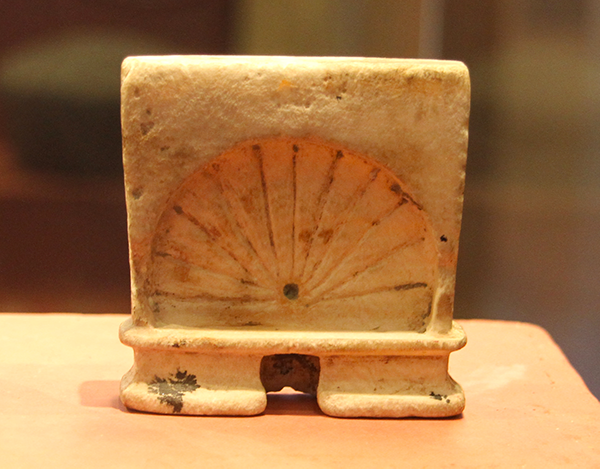
Alabaster sundial (Egypt, circa 350 BCE). The curators
have placed it "upside down" for reasons of stability.