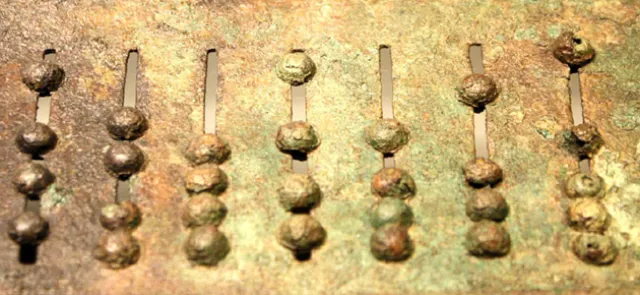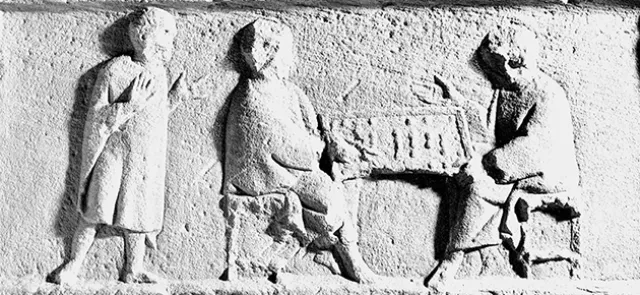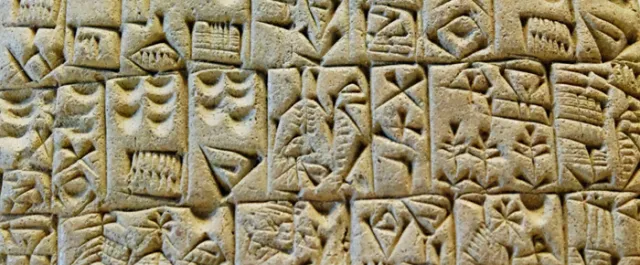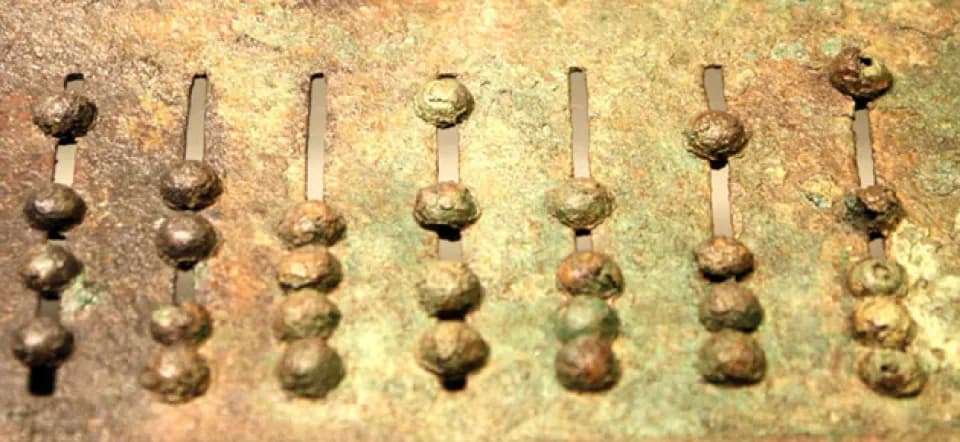
Archaeological excavations not only uncover remnants of the daily lives of ancient peoples, but also bring mathematical objects to light: sticks and more sophisticated counting devices, calculation tablets, papyri recording solutions to problems, instruments for astronomical observation or land measurement, and tools for geometric constructions… Here is an overview of these mathematical instruments of antiquity, used from prehistoric times until the fall of the Roman Empire in 476 CE.
Calculation
Beyond our hands, which allow us to "count on our fingers," the oldest natural aids to calculation were sticks—or any elongated object—and pebbles. To become calculating tools, these objects had to be specially fashioned to represent numbers. The oldest such artifact appears to be the Lebombo bone, found in 1970 in a cave on the border between South Africa and Swaziland and dating to around 43,000 BCE. Made from a baboon fibula, it bears twenty-nine clearly defined notches and may have served as a lunar calendar.
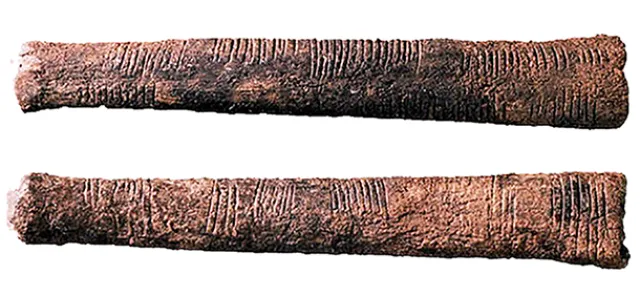
Slightly more recent, at around 20,000 years old, is the Ishango bone, a small bone 10 cm long, discovered in 1950 near Lake Edward in the Congo by Belgian archaeologist Jean de Heinzelin de Braucourt. It is now on public display at the Royal Belgian Institute of Natural Sciences. Some interpret its regularly grouped and spaced notches as numbers. Others even see arithmetic operations in them, while still others see a lunar calendar. Although this relic remains poorly documented, it has certainly thrust the origins of mathematics into the spotlight and brought them considerable media attention—so much so that, in 2000, the Belgian postal service reproduced the Ishango bone's notches along the edge of its stamp celebrating the Year of Mathematics.