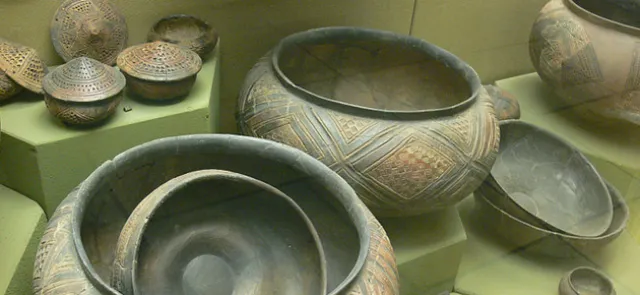
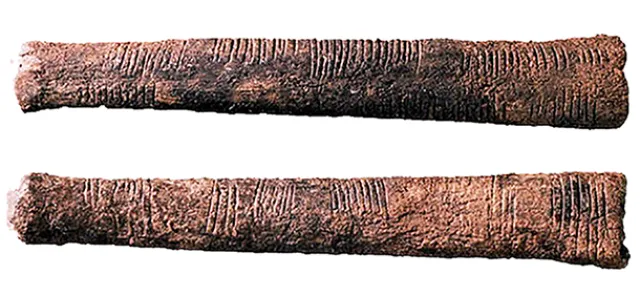
Archaeologists work especially hard to place material evidence from the past within a chronological framework. Every object, whatever it may be—a wall, mosaic, piece of pottery, coin, ditch, temple, house or inscription—must be examined to determine what it is. This involves describing its immediately observable physical and morphological characteristics, in the hope that they bear a definite relationship to time. It is also essential to gather all the information about its surroundings: location, depositional context and association with other objects. Once these conditions have been met, a chronological framework may, for a time, claim some validity pending further data.
“Relative” and “absolute” chronologies
However imprecise they may be, the terms relative chronology and absolute chronology nevertheless describe two equally valid ways of referring to time. The first comes almost naturally to archaeologists, particularly those with few or no written sources, such as prehistorians and protohistorians. In this sense, related objects, such as pottery or archaeological layers, are ordered to reveal the relationships of precedence, succession or simultaneity between them. This is why the chronology is called “relative.” Three tried-and-tested methods can establish such relationships: seriation, stratigraphy and spatial analysis.
“Absolute” chronology aims to place material evidence in calendar time. For schoolchildren, this is the time shown by the timeline running around the classroom walls: linear and calculable. A small number of archaeological objects, such as coins or inscriptions carved in stone, lend themselves to a reading that provides relatively easy access to a date—or rather, to a range of possible dates. In everyday thinking, however, absolute chronology is most readily associated with laboratory-based physical measurements, whether obtained through radiocarbon dating, archaeomagnetism or thermoluminescence.
Bayesian statistics (see the preceding pages) offers a way to reconcile these two approaches. Unlike classical frequentist statistics, it readily incorporates information about the context of events alongside dating measurements. Such information—including temporal ordering relationships inferred from the position of one event relative to another—is incorporated via the prior distribution of the Bayesian model. This technique is particularly valuable when the material culture of the civilizations under study contains no “datable” artefacts whatsoever. Faced with this gap, one might be tempted to seek analogies with neighbouring civilizations whose chronology is better established because their sources are more complete, or simply to defer to a traditional dating scheme. In either case, the proposed chronology would rest on fragile foundations far removed from the actual context of the discovery.