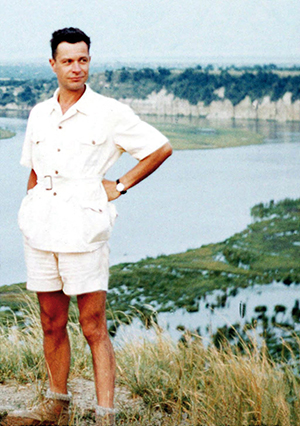
Nothing, a priori, suggested that Jean de Heinzelin de Braucourt would revolutionize the history of mathematics—or at least the prevailing view among mathematicians of its origins. Although drawn to science, mathematics held no special appeal for him. A chemist, geologist and archaeologist, Jean de Heinzelin was brilliant and eclectic. Beginning in 1947, he undertook a series of expeditions to the eastern part of what was still the Belgian Congo. They would prove decisive in shaping his contribution to our understanding of the history of mathematics.
The discovery
-------------
Between 1935 and 1938, the Liège hydrobiologist Hubert Damas (1910–1964) had discovered a motley collection of primitive artifacts along the shores of Lake Edward in the Belgian Congo. They had never been studied in detail and raised a number of questions. The discovery called for further investigation. Victor Van Straelen, then director of the Institut de sciences naturelles, saw Jean de Heinzelin as the right man for the job. His expeditions to Kivu in eastern Congo had made him a leading authority on this part of Africa. He also brought expertise in geology and chemistry, as well as a passion for archaeology.
In 1950, Jean de Heinzelin was officially assigned by the Institut national pour l’étude agronomique du Congo belge to a historical-geology mission in Yangambi. During this first expedition, the geologist made a crucial discovery near the small village of Ishango, on the banks of the Semliki River north of Lake Edward, close to the Ugandan border. It was a small bone covered with numerous notches. This first "Ishango bone" would attract a great deal of attention and may not yet have yielded all its secrets.