



This issue is not fully translated into English yet; only translated content is shown.
Read the French versionAll folders in this issue

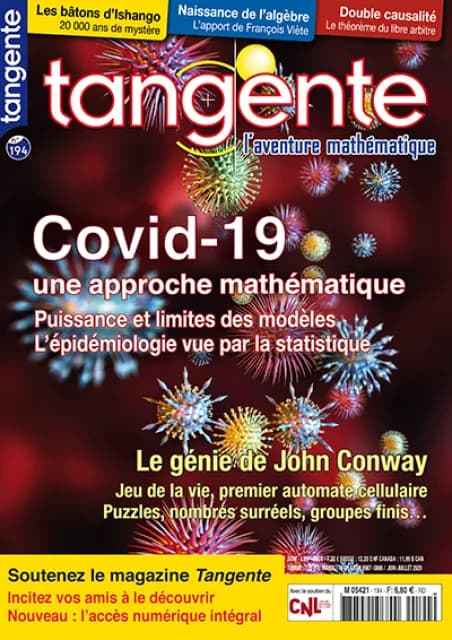
Covid-19, a mathematical approach
Can mathematics also save lives? The Covid-19 pandemic surprised us with its virulence but also with the speed of its spread. Many statistics, sometimes contradictory, have been published. Mathematical models allow us to understand, study, and predict the phenomena around us. But what can be their contribution when so many unknowns remain? By quantifying and explaining their direct consequences on the spread, do the models justify certain measures to be taken, however painful they may be? The mathematical tools used to understand the complexity of living things remain only approximations that can point to explanatory paths, but cannot replace a real understanding of the phenomena. The alliance of mathematics and other sciences will, let us hope, make it possible to make the right decisions.


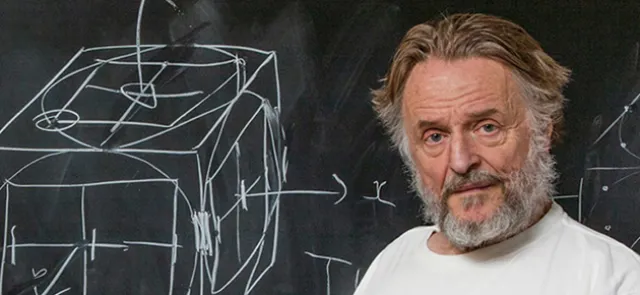
The genius of John Conway
John Horton Conway, a brilliant mathematician, passed away at the age of 82 on April 11, in New Brunswick (New Jersey, United States). Both a creator with boundless imagination in many fields – especially games – and an exceptional popularizer, he embodied the ideal mathematician that Tangente could dream of. Through his talent, John Conway advanced mathematics in various fields: finite groups, number theory, geometry and geometric topology, theoretical physics, combinatorics and game theory. But it is more particularly the "Game of Life" that made him famous, allowing a wide audience to discover mathematics in a new light, both playful and profound. This game was used, among other things, for modeling the spread of an epidemic. Tragic coincidence, it was complications related to the coronavirus that claimed the life of its creator.


All articles in this issue
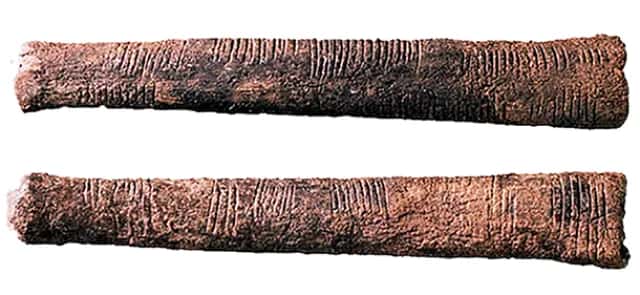
Ishango bones finally deciphered?
The earliest mathematical object is more than twenty thousand years old. It was discovered by chance in the heart of Africa by a Belgian geologist. Its interpretation remains a matter of debate to this day.

Mr Viète's new algebra
François Viète ranks among those scholars celebrated for their considerable contribution to mathematics. He did not invent algebra, but his work propelled the discipline forward spectacularly.
A game showcasing the richness of combinatorics
Radical X is a compact game packaged in a rectangular box with edges measuring less than 5 cm.