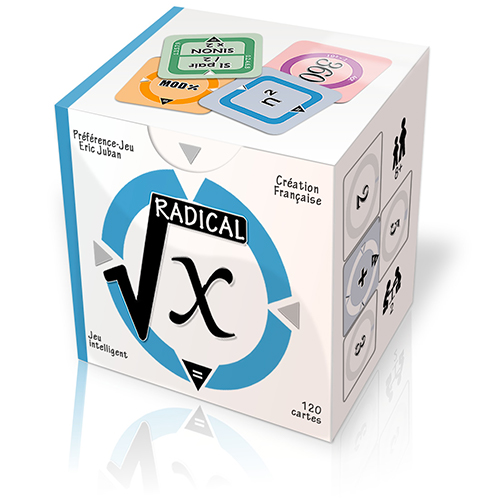
You can take it anywhere. The sequences of calculations, however, require quite a large area (allow at least 60 cm by 60 cm).
Inside are 120 cards—but no rules! You have to consult them on the **www.radical-x.com** website. The creator has fully embraced the digital approach, with an app for keeping score and a calculator tailored to the game.
Radical-X is played by two players or by teams. Some cards show numbers on the front and a written description of the number on the back (such as "Number of pins in bowling" for "10"). There are also "operator" cards, which form the heart of the game. An "operator" can combine one, two, or three numbers. A few special cards round out the set. The rules explain in exhaustive detail how to use the cards, with (thankfully) plenty of examples of play. However, we found the setup and phases of the game rather unclear on the website. Another debatable feature is that points are tallied as the game progresses, after each turn, unlike in a game where the winner is determined at the end.
The game soon seems quite interesting, especially from an educational standpoint, thanks to the extensive combinatorics involved. The way the blocks are assembled strongly evokes programming.
Although the game offers a wealth of possibilities and showcases the rich combinatorics of numbers, it takes a little effort to get started.