



Jean-Jacques Dupas
107 articles published in Tangente
 Maths and artN°98Jun 08, 2026
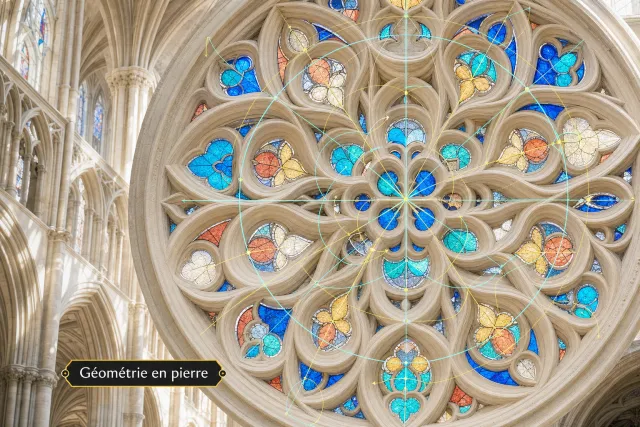
Symmetries in Gothic architecture: from cathedrals to dihedral groups
Discover how Gothic architects mastered symmetry to create geometric masterpieces in cathedrals, with orders of symmetry as high as 8.
Read → N°97Feb 11, 2026
Caroline Herschel, professional astronomer
Caroline Herschel (1750–1848) was not destined for astronomy. Thanks to her brother, she became first a singer and then an astronomer. Their partnership led her to discover new comets and become the first woman to work professionally as an astronomer.
Read →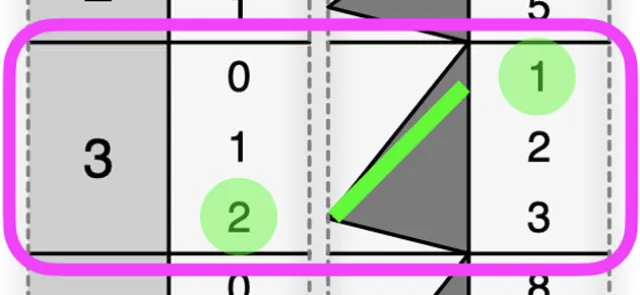 Math for everyoneN°95Aug 22, 2025
Conquering carries
Napier's rods had simplified multiplication, but handling carries remained an unsolved problem. The obstacle they posed remained insurmountable for three and a half centuries, until Genaille and Lucas finally found a solution.
Read →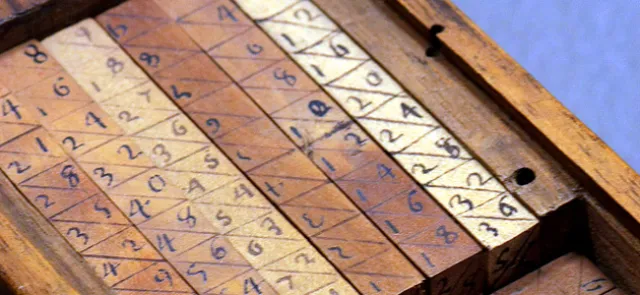 Math for everyoneN°95Aug 22, 2025
Napier's bones
With the advent of calculators and, later, smartphones, people have become less and less likely to work out a multiplication, division or square root by hand. Yet for centuries this was a problem, inspiring a host of ingenious ways to streamline calculations. One such invention was Napier's bones, which effectively automated multiplication.
Read →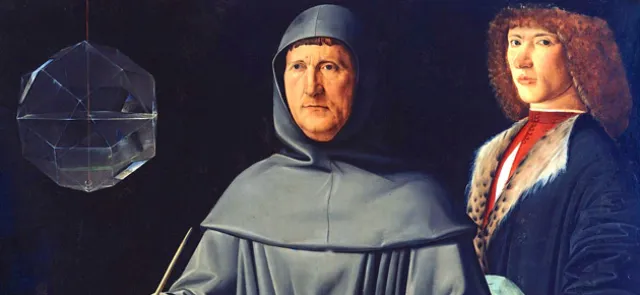 Math for everyoneN°95Aug 21, 2025
The rule of 72
Interest-rate and monthly-payment problems are hard for our brains to grasp, because we struggle to picture an exponential phenomenon. During the Renaissance, however, trade expanded, bringing with it a growing need for calculations of this kind. This led to the development of new shortcuts.
Read →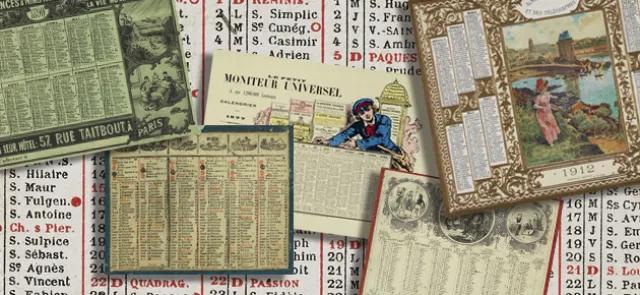 Math for everyoneN°95Aug 21, 2025
What day will Judgment Day fall on?
A classic mentalist trick is to work out instantly, in their head, which day of the week corresponds to a given date. How do they know at once that January 27, 1962, was a Saturday? Here are some of the methods they use for our Gregorian calendar.
Read →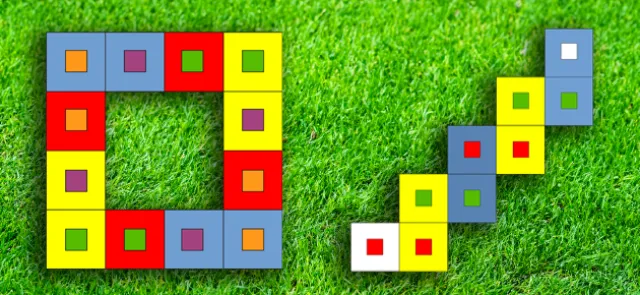 Math for everyoneN°225Aug 18, 2025
Tetraflexagons, squarely strange
Unlike hexaflexagons, known for their regularity, tetraflexagons, whose faces are squares, have always escaped systematic study. They exhibit several types of cycles, and the complexity of handling them contrasts sharply with the apparent simplicity of their shape.
Read →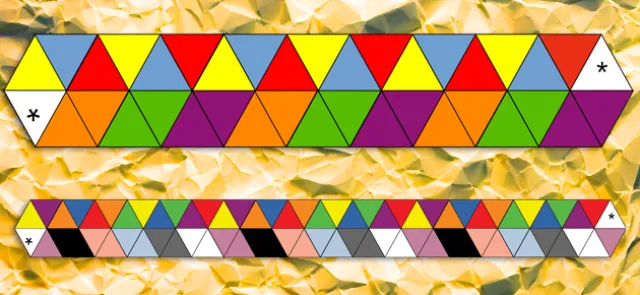 Math for everyoneN°225Aug 18, 2025
In the land of hexaflexagons
The first hexagonal-faced flexagon studied had three stable positions. Methods were quickly found for constructing an associated hexaflexagon for a given number of stable positions — and even several different hexaflexagons…
Read → Math for everyoneN°225Aug 18, 2025
The trick wallet,
Although hexaflexagons were identified by Stone, the shape of the first tetraflexagon had been known for a very long time. This is a double-acting hinge.
Read → Math for everyoneN°94May 12, 2025
The Trinity College gang and the square
In the 1930s, the problem of dissecting a square into smaller squares of different sizes gave rise to two conjectures by Erdős. They would be disproved by four Trinity College students who threw themselves into the research.
Read → History and CultureN°221Dec 16, 2024
Sophie's World
Born around 1763, Sophie de Grouchy married Condorcet, whom she had met at the home of her uncle and mentor, President Mercier du Paty.
Read → Math for everyoneN°92Dec 04, 2024
Vertex figure
A polyhedron is an assembly of polygons with vertices, edges and faces, arranged so that every edge is shared by two faces.
Read →