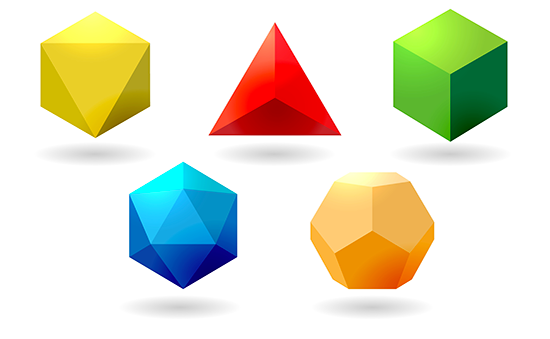
In Euler's formula for convex polyhedra, F – E + V = 2, the number of faces F and the number of vertices V play symmetric roles. This symmetry gives rise to duality. In three-dimensional space, duality is an operation that transforms polygons into points and points into polygons.
But how can we construct a polygon from a vertex of a polyhedron? This is where the vertex figure comes in.
The construction is simple: start at a vertex and move the same distance along every edge incident to it. The concept of a vertex figure allows us to characterize the vertices of a polyhedron in terms of polygons. We can therefore describe a polyhedron using polygons alone: its faces and vertex figures.
This concept even provides a remarkably concise characterization of the Platonic solids: a polyhedron is regular if its faces are congruent regular polygons and its vertex figures are congruent regular polygons. The Schläfli symbol for polyhedra emerges naturally!
| Polyhedron | Faces | Vertex figure | Schläfli symbol |
|---|---|---|---|
| Tetrahedron | {3} | {3} | {3, 3} |
| Cube | {4} | {3} | {4, 3} |
| Octahedron | {3} | {4} | {3, 4} |
| Dodecahedron | {5} | {3} | {5, 3} |
| Icosahedron | {3} | {5} | {3, 5} |