Histonumbers
----------------
Triangular, square, pentagonal and other figurate numbers are well known and discussed in this special feature. But what about the inverse operation, starting with any number and turning it into a polygon? Let's explore a few ways of constructing such polygons—admittedly somewhat artificially—whose shapes can sometimes be rather strange.
A very natural idea is to represent each digit c of an integer, written in decimal notation, by a column of c stacked unit squares. Let's polygonize 143 in this way:
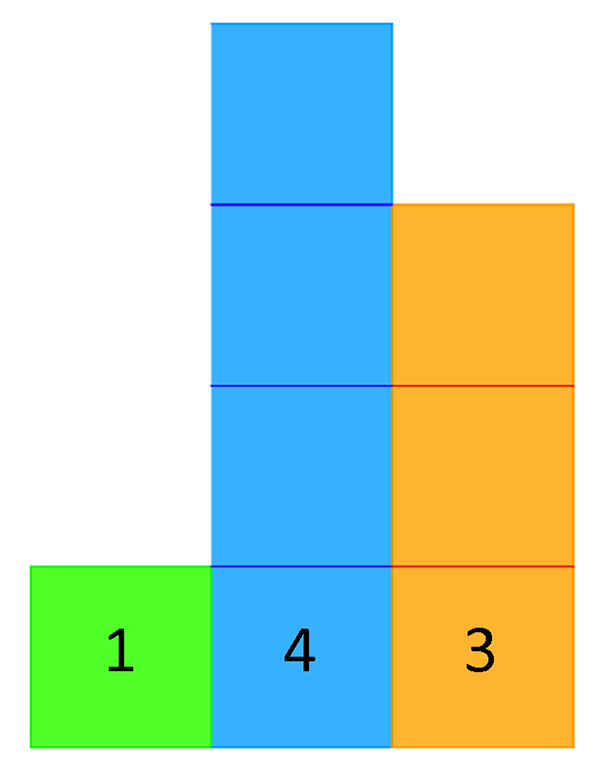
Its area equals the number of squares it contains, that is, the sum of its digits—8 in this case. For an n-digit number N, it is easy to check that if every digit other than the largest, *Mn, is adjacent to a larger digit, its perimeter is P(N) = 2(Mn + n). The numbers 143 and 134, together with their “mirror images” 341 and 431, therefore produce polygons with the same area, S = 8 (= 1 + 3 + 4), and the same perimeter, P = 14 (Mn = 4 and n* = 3).