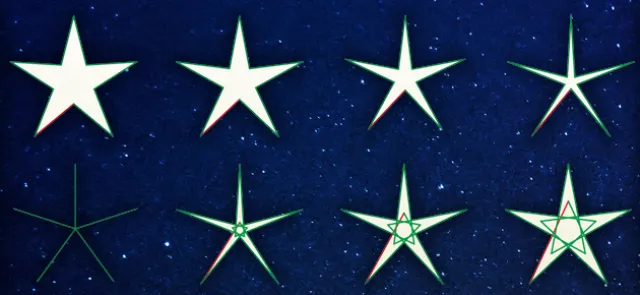
The Schläfli symbol of the mystical pentagram is {5/2} (see page 14). This polygon therefore has five edges, each joining a vertex s to vertex s + 2, when the vertices are numbered in their natural cyclic order.
A universal symbol
--------------------
Widely regarded as one of the oldest and most universal symbols, it has been interpreted in various ways. The upright and inverted pentagrams thus have opposite meanings: the upright pentagram, with its point facing upward, is said to symbolize the primacy of spirit over matter, while the inverted pentagram, with its point facing downward, is said to represent the supremacy of matter over spirit.
The earliest known depictions of star pentagons, rudimentary though they are, were discovered on various objects from ancient Sumerian cities dating from the 4th millennium BC. Between 570 and 480 BC, the pentagram, or "signum pythagoricum", was used as a distinctive symbol by Pythagoras and his disciples. They placed it at the bottom of their letters, beside their signature, as a mark of courtesy meaning something akin to "Take care". Around 1492, Leonardo da Vinci depicted Man in the form of a pentagram in his Étude de proportions du corps humain selon Vitruve (Study of the Proportions of the Human Body According to Vitruvius).
As well as appearing on many religious buildings, it can be found in the design of the historic city of Washington, whose plans were drawn up by Pierre-Charles L’Enfant, a French engineer, urban planner and architect born in Anet (Eure-et-Loir) in 1754.