Tangente: Professor Penrose, thank you for agreeing to answer our questions. Here at Tangente, we are delighted that you were awarded the 2020 Nobel Prize in Physics, jointly with two physicists!**
Sir Roger Penrose: Thank you! This prize seems to have pleased mathematicians. I find that somewhat ironic: the prize was awarded to me for discovering that "black hole formation is a robust prediction of the general theory of relativity". But that is not what I discovered! What I showed was that singularities *see the article ["Singularities in general relativity"] are a robust prediction of the general theory of relativity. And you need "cosmic censorship" see the article ["Singularities in general relativity", § It's cosmic!]* to say that you are talking about black holes.
As for cosmic censorship, do you stand by your conjectures as they are, or would you like to revisit them?
There are non-generic timelike singularities. In its strong form, the cosmic censorship conjecture states that generic singularities are spacelike. I still think this is true, but I still have no proof!
Beneath the paving stones, the tiling
-------------------------
We would like to return to your research on aperiodic tilings. In 1973, you found six tiles that could enforce an aperiodic tiling. How did you manage to reduce their number first to four, then to two?
Ha ha! I can tell you the story… I began by subdividing a pentagon. I had been invited to give a lecture at one of the colleges belonging to the University of London. As I replied to their letter, I noticed that their logo in the corner was a pentagon subdivided into six smaller pentagons: one in each corner and one in the middle. Triangular gaps lay between the pentagons.

The logo of South Bank University in London.
I then tried iterating this pentagon-subdivision procedure over and over again. The gaps multiplied, and I had to decide how to fill them. I put pentagons in them. The remaining spaces were rhombi and star-shaped decagons—that is, pentagrams without their inner lines. I called the central part with three "points" a half-pentacle, although strictly speaking it amounts to more than half a pentagram. Together with the rhombi, this was all I needed to define a non-repeating pattern. I later learned that a Japanese man had done almost exactly the same thing as me, slightly earlier, I believe, but had made a different and unsuccessful choice when filling the remaining spaces.
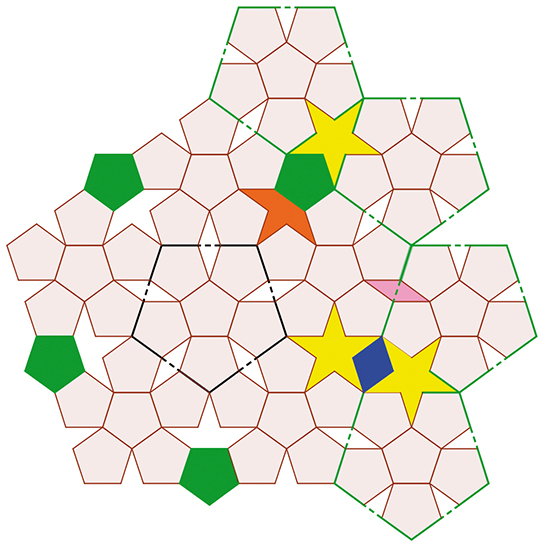
The large pentagon is subdivided into six smaller pentagons, each itself containing six still smaller pentagons. The spaces left empty can be filled, as desired, with new pentagons (green), "half-pentacles" (orange) and two types of rhombi (blue and purple).
Later, I saw that one could make a puzzle. [This is why Roger Penrose patented these tiles.] For the puzzle pieces, I needed only three different versions of the pentagon: one surrounded by five others, one surrounded by three others and one surrounded by two others. [In the diagram, each pentagon shares a side with either two, three or five pentagons.] There are natural matching rules that enforce the configuration. [The matching rules, or local rules, are of two kinds: drawing coloured curves on the tiles, or altering the tiles' edges by curving them or adding projections and notches.] I then had an aperiodic tiling made up of six pieces: the three versions of the pentagon, the half-pentacle and the two rhombi.
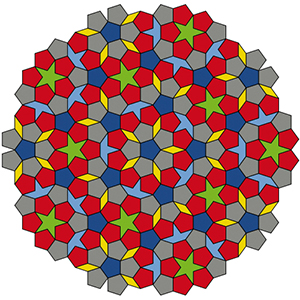
An aperiodic tiling of the plane using Penrose's six original tiles.
A conjecture disproved
-----------------------
I had heard about a paper by Raphael Robinson [in 1971] on Hao Wang's decision problem: given squares with coloured edges, the task is to assemble them to tile the plane so that the colours match along every shared edge. Is there an algorithm for deciding whether these pieces can tile the plane? Wang had proposed the following conjecture: any set of tiles that can tile the plane can do so periodically. If this is true, then there is an algorithm for determining whether or not a finite set of tiles can tile the plane. But one of his students, Robert Berger, showed that no such decision procedure could exist. [The answer to Wang's decision problem is therefore negative.] Part of Berger's argument consisted in showing that there is a finite set of N tiles that can tile the plane only non-periodically. Berger had proved this for N > 100; Robinson showed that N = 6 works.
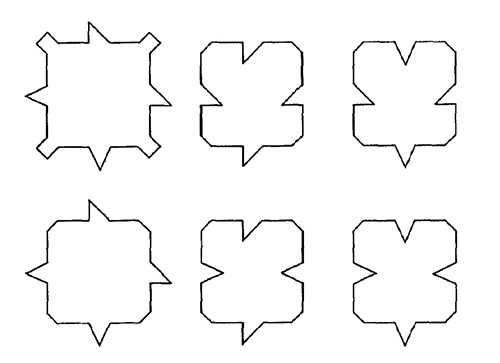
Raphael Robinson's six tiles, which can
tile the plane aperiodically.
I knew how to do it with N = 5: the particular configuration of the six pieces allowed me to combine three of them to create two new ones, thereby eliminating one. But could I do better? Before long, I had managed it with four tiles. Could I do better still? I got the number down to two by rearranging, cutting up and dissecting the previous four shapes. My reaction was: "This is ridiculous—what a disappointment! It's so simple, it must already be known!" And yet…
I had two suitable sets of N = 2 tiles. The first one I found was the kite and dart. The obstructions are fairly obvious: instead of fitting one dart into the kite, you have to fit two. Then I arrived at the two rhombi. With this second set, unless you have the right matching rules, there is no apparent reason why the tiling should be forced to be aperiodic.
Challenges ahead
-------------------
I showed John Conway both the original version and a "bird-shaped" version of my two favourite tiles, the kite and dart; he would have loved to discover those shapes himself. He then spent several days, I think, discussing them with Martin Gardner, which led to an article in Scientific American [Extraordinary non-periodic tiling that enriches the theory of tiles, Scientific American 236, January 1977].
The amateur mathematician Robert Ammann then wrote to Gardner: independently, and by a completely different method, he too had obtained the aperiodic tiling with two rhombi! The Ammann–Beenker aperiodic tiling has rotational symmetry of order 8 [the tiling is invariant under rotation through an angle of 2π / 8 radians, or 45°]. The real question is: had he found an aperiodic tiling with rotational symmetry of order 5?
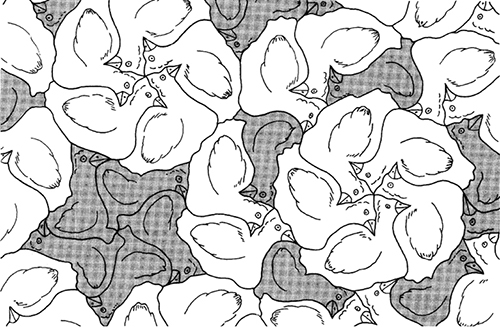
The "bird-shaped" version of Penrose's aperiodic tiling
(rotational symmetry of order 5).
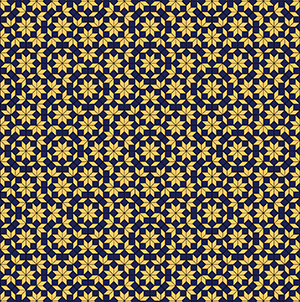
The Ammann–Beenker tiling (rotational symmetry of order 8).
It is surprising that these tilings do not appear in art or in the work of earlier geometers…
My father owned a volume containing two of Kepler's books. It included [in Harmonices Mundi, 1619] illustrations of several non-crystallographic shapes and several different tilings. The largest image, which Kepler called Aa, is an arrangement of pentagons. I had seen this pattern but had forgotten it. Somewhere in my mind, no doubt, the idea had taken root that studying pentagons was not a waste of time, that there were still things to be done with them.
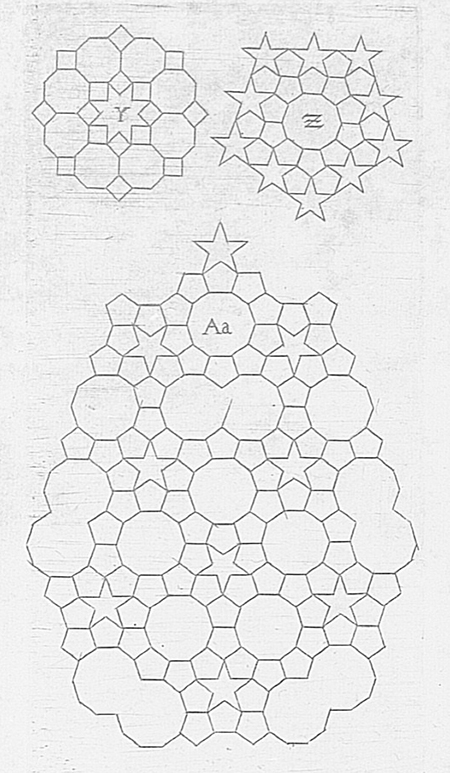
Figure Aa, from Kepler's Harmonices Mundi.
One day, I was visiting Bern, Switzerland. At the time, there was great interest in quasicrystals. [Daniel Shechtman would later receive the 2011 Nobel Prize in Chemistry for his research on quasicrystals during that period.] Robert Ammann had found an aperiodic tiling with rotational symmetry of order 8, and there were others of orders 10 and 5. Hans-Ude Nissen then told me that he believed he had found an aperiodic tiling with rotational symmetry of order 12. He showed me his images. One was a diffraction pattern, with isolated points. The points were arranged symmetrically and exhibited rotational symmetry of order 12. A grid in the background made it possible to draw a network of triangles and squares. I wondered where I had seen that before. It was in Kepler's book! Figure Ff shows exactly this arrangement: a dodecagon with some triangles pointing inward and others pointing outward, with squares nestled between pairs of triangles. Nissen really had discovered an aperiodic tiling with rotational symmetry of order 12, but no one wanted to believe him…
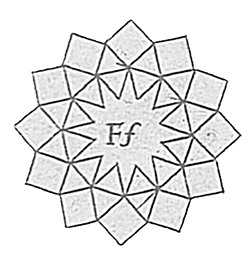
Figure Ff, from Kepler's Harmonices Mundi.
Other questions remain open concerning the symmetries of aperiodic tilings and the smallest sets of tiles that can generate them…
Yes. So aperiodic tilings of orders 5, 8, 10 and 12 are known. For order 12, three tiles are used: a regular dodecagon, a square and a hexagon bearing markings that enforce aperiodicity. [Other sets of three tiles may also work—for example, a square, a triangle and a rhombus.] I do not know whether an aperiodic tiling of order 12 can be created with only two tiles. Now that is an interesting question!
As for artificial intelligence (AI), one might ask: given these pieces with no other information, can an AI infer the rules that enforce an aperiodic tiling? This is easy to program, because the tiles lie on a hexagonal lattice, unlike pentagons; one need only decide which pieces to place around the dodecagon, and in what order. I would be curious to know whether the AI would get stuck fairly quickly or manage to find a way of continuing the tiling indefinitely. I am sure that automated tools for recognising shapes or patterns would be no help at all! The tiling is constructed by starting with one of the three pieces, subdividing it so that only those same three pieces appear, "zooming in", then repeating, thus proceeding "from the outside in". *This is the deflation/inflation process described in the article ["Singularities in general relativity" in § Deflation–inflation duality.]* If the AI were asked to work "from the inside out", methodically assembling the tiling from the pieces, I am not sure it would get very far…
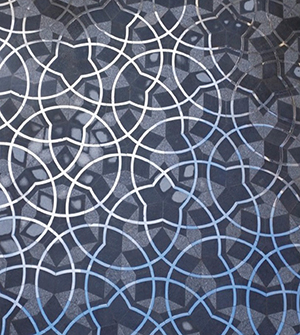
A Penrose aperiodic tiling at the entrance to the Mathematical Institute in Oxford (United Kingdom), made with two rhombus-shaped tiles. The curved lines represent the constraints imposed by the matching rules.
Or take the rhombus tiling at the entrance to the Andrew Wiles Building in Oxford. It is a tiling I am rather proud of, and one that appears nowhere else. The curved lines wind through it and form four kinds of closed shape: perfect circles, "double circles" [one can be seen running vertically on the right-hand side of the image], "large rounded decagons" [one is just visible at the bottom right, extending far beyond the image], and a "rounded pentagon" [the "little five-petalled flower" at the centre of the image]. Are there any other non-self-intersecting closed curves in this tiling? I thought not. Then I discovered a fifth, highly complicated closed shape, which changed my mind. I now conjecture that "almost all" the curves appearing in this tiling are in fact closed!
And no one has yet found a solution to the "ein Stein conjecture". I do not think the existence of such a shape is impossible…