



Roger Penrose
A mathematician, Nobel Prize in Physics! The 2020 Nobel Prize, awarded to Sir Roger Penrose, Andrea Ghez and Reinhard Genzel, is an opportunity to look back on the beautiful story of an exceptional scholar, passionate and enthusiastic, whose work in topology helped clarify our understanding of black holes. His training in pure mathematics concluded with a thesis in algebraic geometry. His ingenious discovery of impossible figures and aperiodic tilings made him known to the general public. The establishment of the first theorem on singularities in general relativity led to the justification of the existence of black holes. Sir Roger Penrose, generous with his time and energy, delivers in this issue of Tangente an exclusive interview.
All articles in this folder
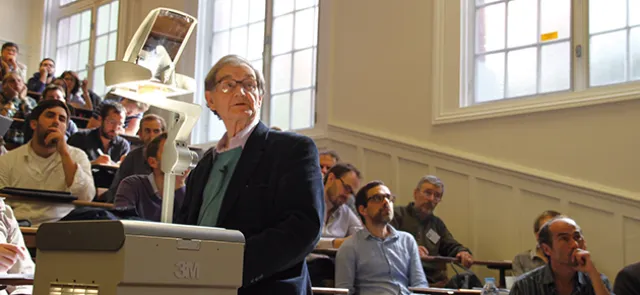
An extraordinary scientist | Tangente
How did a pure mathematician trained at Cambridge come to win the Nobel Prize in Physics at the age of 89? This is the remarkable story of an extraordinary scientist who realized that his work in topology could help shed light on black holes.
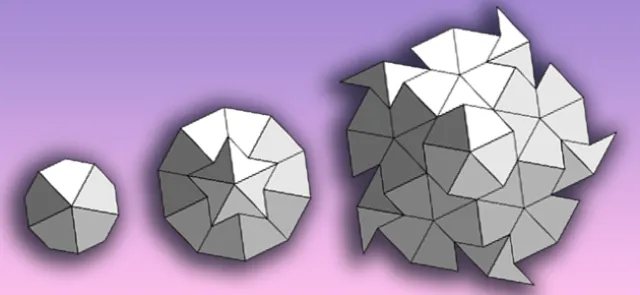
Dazzling Penrose tilings
Sir Roger Penrose is renowned for his remarkable and foundational work in geometry and cosmology, and for the applications of that work to black holes. It is puzzling, however, that he is famous to the general public for the tiling that bears his name, with its many remarkable properties.
A Nobel prize for black holes | Tangente
The 2020 Nobel Prize in Physics honors black hole astronomy. Thanks to Roger Penrose, Andrea Ghez and Reinhard Genzel, general relativity has at last been recognized by the celebrated Swedish institution—something that, surprisingly, had rarely happened before!
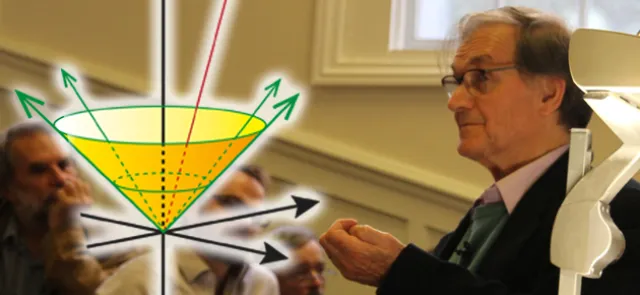
Singularities in general relativity
The year 1965 saw the first modern theorem on singularities in general relativity, due to Roger Penrose. This geometric result would have major implications for the origin of the universe and the collapse of massive stars.
Penrose interview: 2020 Nobel laureate | Tangente
Three books to finish. Hundreds of journalists on the lookout since the Nobel Prize in Physics was announced on October 6, 2020. Yet Sir Roger Penrose, aged 89, agreed to give your favourite magazine more than three hours of his time in a video interview. With generosity, passion and enthusiasm, he tells us the story behind some of his geometric discoveries.
Penrose's impossible figures | Tangente
Penrose's name is associated with several "impossible objects."
Nobel prizes in physics and mathematics | Tangente
The most famous winner of the Nobel Prize in Physics is probably Albert Einstein, honored in 1921 for his work on the photoelectric effect—not for his celebrated theory of relativity.
Penrose and the Kleenex affair | Tangente
In the 1970s, Roger Penrose filed patent applications for several of his aperiodic tilings (!) and founded a company, Pentaflex, to manage the patent rights.
Penrose and the sharing of knowledge | Tangente
Sir Roger Penrose is an outstanding popularizer, both in print and as a speaker.