The Penrose triangle
----------------------
One example is the Penrose triangle, also known as the tribar or impossible triangle. It consists of three interconnected beams depicted in two dimensions. Together with his father, Lionel Penrose (1898–1972), Roger Penrose published a drawing of it in an article in the British Journal of Psychology in February 1958. The idea had come to him after discovering the work of Dutch printmaker Maurits Cornelis Escher (1898–1972) while attending the International Congress of Mathematicians in Amsterdam in 1954.
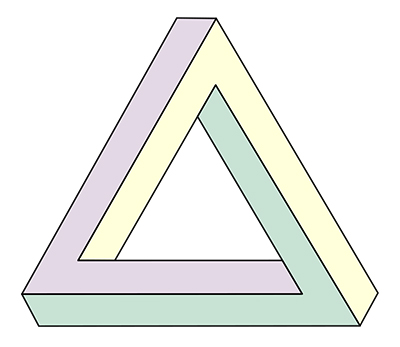
The Penrose triangle.
In fact, Swedish artist Oscar Reutersvärd (1915–2002) was the first to draw a series of nine cubes in the same configuration. This was in 1934, during a Latin class in which, by his own account, he was bored.
This discovery changed the course of his life. During his career as a graphic designer, he drew a great many "impossible figures" and is sometimes known as the "father of the impossible." In tribute to him, Sweden issued a series of stamps in 1982.
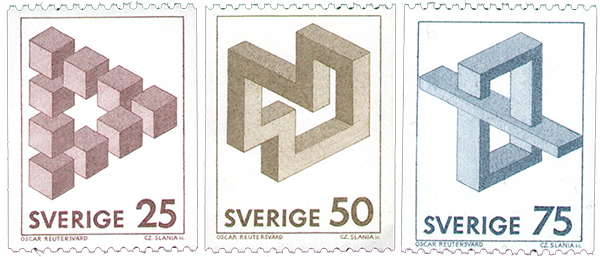
Swedish stamps commemorating Reutersvärd.
Clearly, neither the Penroses nor Escher knew of the figures Reutersvärd had created years earlier.
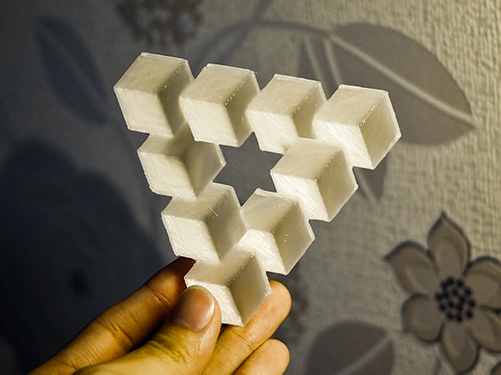
A rendering of Reutersvärd's illusion
(see if you can guess the trick used to make it!).
The Penrose staircase
---------------------
Another "impossible figure" appeared in the Penroses' 1958 article: the staircase. Yet here again, Reutersvärd had already described the figure, in 1937!
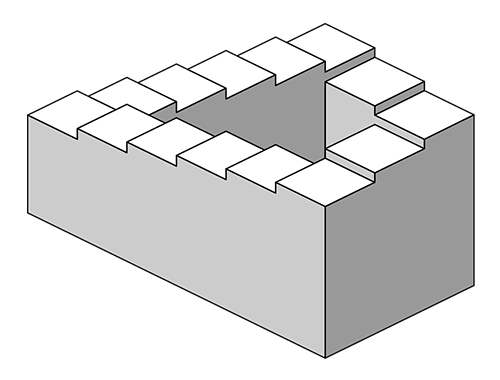
The Penrose staircase.
Escher learned of this object through exchanges with Roger Penrose. As early as 1960, he drew on it to create the now-famous lithograph Montée et Descente. Andrew Lipson and Daniel Shiu succeeded in recreating this work (and many others; see the website, ) using LEGO bricks…
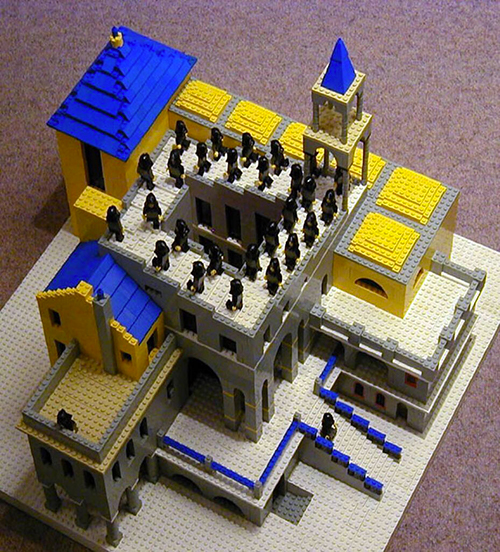
Escher's Montée et Descente recreated using LEGO bricks (see if you can spot the device the artists used!).
References:
Maths et arts plastiques. Bibliothèque Tangente 23, 2018.
Inventions mathématiques. Jean-Paul Delahaye, Pour la Science, 2014.
Les secrets des dimensions. Bibliothèque Tangente 66, 2019.