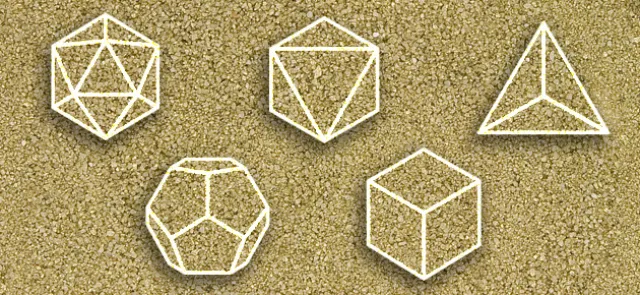
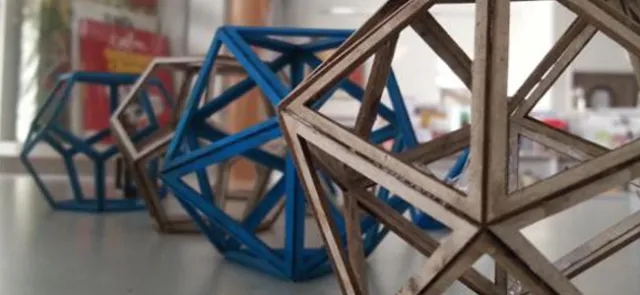
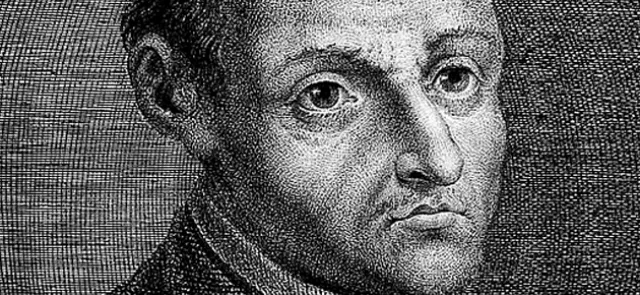
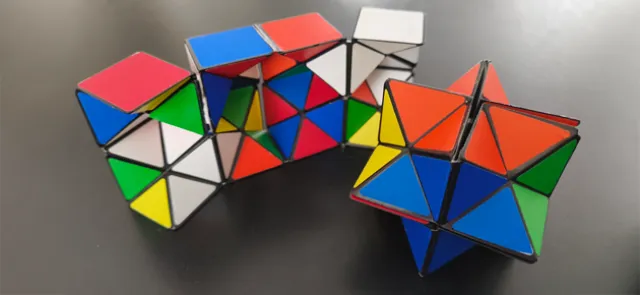
After extensive training at the Manufacture des Gobelins and then at the École du Louvre, Sylvie Donmoyer became an illustrator. Two encounters would shape her artistic exploration of mathematics. First, the engravings of Maurits Cornelis Escher (see Tangente 144) introduced her to the world of mathematics through an imaginary realm steeped in mystery and poetry. Then, during a long stay in the United States, she met the mathematician Jean Pedersen, with whom she collaborated. She developed a strong interest in mathematical forms, particularly polyhedra, which feature in several of her works. "It all sprang from the sense of wonder I felt on seeing the formal beauty of those mysterious objects called polyhedra. Ever since, I have played with geometric forms, and this has led me to explore the possible ways of representing geometry in classical painting," she explains.
Her interest in polyhedra remains undiminished in Tapisserie mathématique, which features polyhedral origami arranged before a hanging printed with numerous mathematical formulas
-
Conveying a... mathematical emotion
--------------------------------------
One of Sylvie Donmoyer's aims is to convey the aesthetic response she feels when looking at a mathematical object, even though she has no mathematical training and is first and foremost an artist. She uses geometric forms to offer a "visual interpretation of mathematics". She thus embodies the bridge between the two worlds of art and mathematics.