Cauchy’s very first mathematical work appeared in February 1811 in the Journal de l’École polytechnique. It addressed a question about polyhedra posed by Louis Poinsot (1777–1859), a mathematician twelve years his senior.
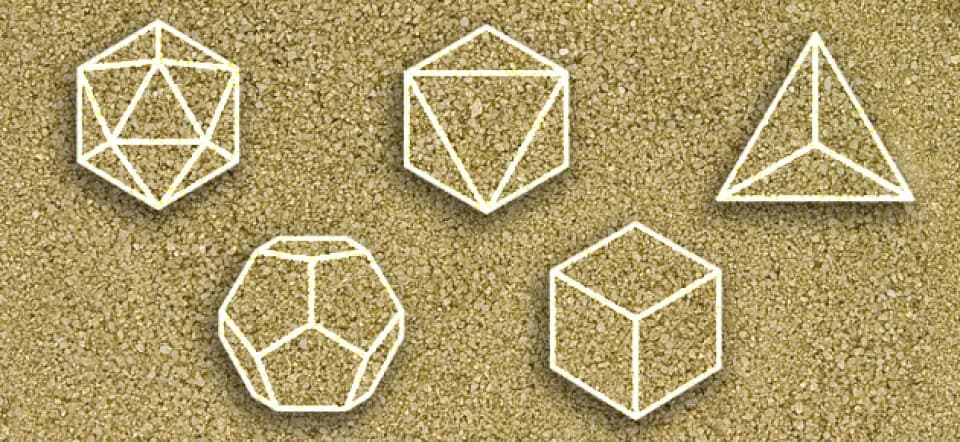
As is well known, there are only five so-called regular polyhedra: convex solids whose identical faces are regular polygons (that is, polygons with equal sides meeting at equal angles). In ascending order by number of faces, they are the tetrahedron (4 triangular faces), the cube (6 square faces), the octahedron (8 triangular faces), the dodecahedron (12 pentagonal faces) and the icosahedron (20 triangular faces). With only five possible regular polyhedra, this is a far cry from the infinitely many regular polygons. Also known as the Platonic solids, these polyhedra have been studied and generalized since antiquity, notably by Kepler.
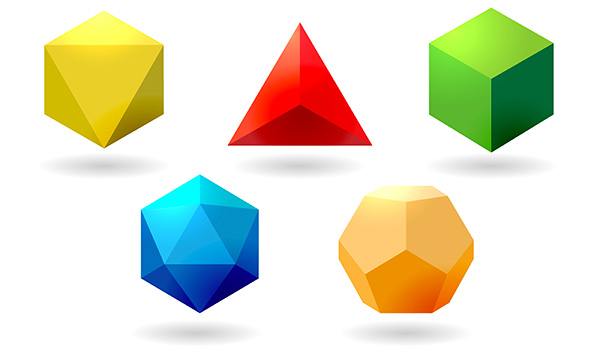
The Platonic solids: octahedron, tetrahedron, cube, icosahedron, dodecahedron.
Poinsot, the trailblazer
---------------------