The first person to investigate polyhedra whose faces are all rhombi appears to have been the German astronomer Johannes Kepler (1571–1630). In his book Strena sive de Nive sexangula, published in 1611, he asks why snowflakes possess sixfold symmetry. Naturally, he also considers other forms in nature with hexagonal symmetry and turns his attention to honeycombs. He observes that the base of each cell consists of three congruent rhombi. These rhombi inspire a new geometry problem: could a (convex) solid, analogous to the five Platonic solids and the fourteen Archimedean solids, be constructed entirely from rhombi?
Rhombic monohedra
------------------------
A solid whose faces are all rhombi is a rhombic polyhedron. For such solids to "resemble" the Platonic solids, all the rhombi must be "the same." A solid whose faces are all congruent is a monohedron.
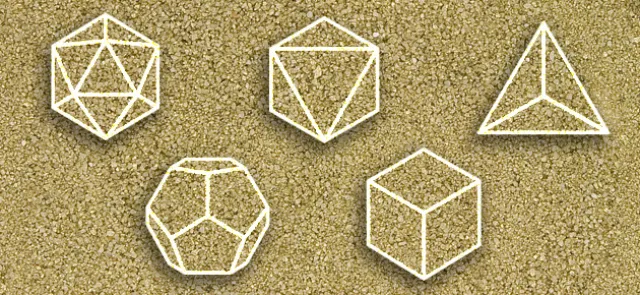
Kepler finds two solutions to his problem: the rhombic dodecahedron (with twelve faces), which has the symmetry of the cube and the octahedron; and the rhombic triacontahedron (with its thirty faces), which has the symmetry of the dodecahedron and the icosahedron. The cube, which would be a "rhombic hexahedron" here, appears to be a third solution. Is a square not simply a special rhombus?