The rhombic dodecahedron is an extraordinary polyhedron! It occurs in nature: many crystals do indeed have this shape. It can be found in the plant kingdom, in pomegranate seeds, for example, which is why François Lo Jacomo calls it a granatohedron. It also appears in the animal kingdom: the bases of the cells in honeycombs have this shape too.
The first person known to have studied this twelve-faced convex polyhedron—each face being a rhombus whose long and short diagonals are in the ratio —seems to have been Johannes Kepler, in Hamonices Mundi (1619). But here we are not interested in the rhombic dodecahedron itself: it is its first stellation that demands our attention.
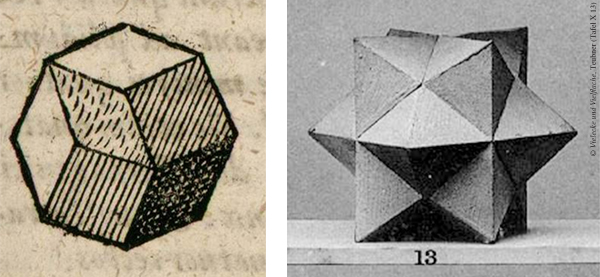
*Left: The rhombic dodecahedron from Hamonices Mundi.
Right: The first stellation.*