Euler's formula states that, for a polyhedron satisfying certain conditions, if S denotes the number of vertices, F the number of faces and A the number of edges, then
S + F – A = 2.
It is remarkable in more ways than one (see the feature devoted to this formula in Tangente 174, 2017). Remarkably simple, it builds a bridge between geometry (polyhedra) and arithmetic (S, F and A are integers). It also introduces the notion of duality…
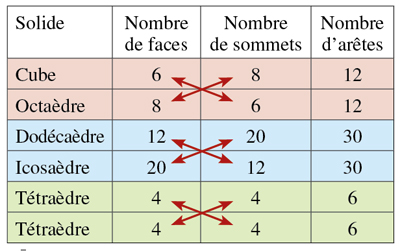
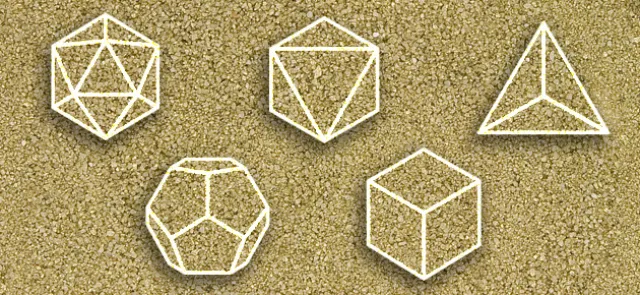
We often read that the tetrahedron is "its own dual." In fact, the dual of a tetrahedron is another tetrahedron. Duality pairs a vertex with a face. More precisely, a vertex where n faces and n edges meet can be paired with a face having n sides, and conversely (a face with m sides can be paired with a vertex where m faces and edges meet).