



Duality, theorems that come in pairs
At the beginning of the 19th century, mathematician Joseph Gergonne thought he had discovered a new world when he understood that one theorem was born from another by interchanging the terms 'point' and 'line' in a statement. In a broader sense, this analogy had already been highlighted, particularly within the framework of Platonic solids. Later named duality, it allows, by 'reversing' two 'dual' concepts, to achieve strikingly quick proofs. Duality was the cradle of projective geometry. It is found today in many fields: set theory, logic, linear algebra... Analysis has also taken hold of it within the framework of functional spaces.
All articles in this folder
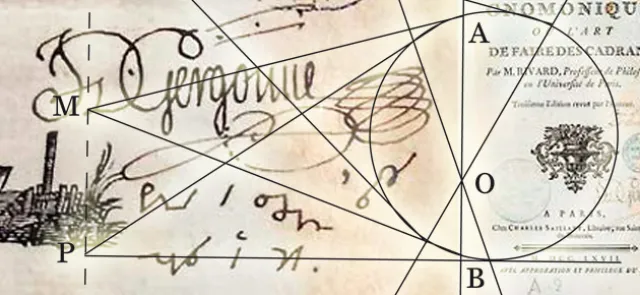
Partner-swapping in geometry
Duality has appeared in many branches of mathematics, from the Platonic solids of antiquity onward. It came into its own in projective geometry in the early 19th century, emerged soon afterward in logic with George Boole and Augustus De Morgan, and later flourished in linear algebra.

Mathematical controversy over duality | Tangente
The word "duality" comes from the Late Latin dualitas, which had displaced the classical term duales, used to describe something associated with two (duo in Cicero's Latin).
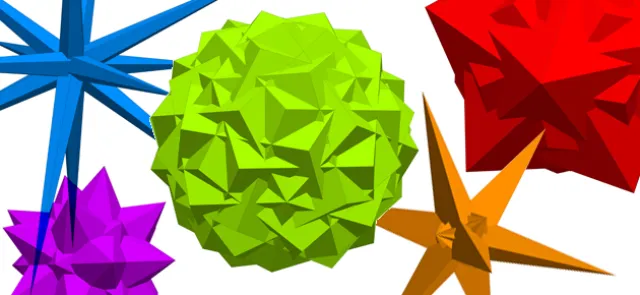
When polyhedra come in pairs
Swapping the faces and vertices of a polyhedron produces a new one, which can be built using elementary geometric constructions. This phenomenon once again demonstrates the close connection between arithmetic and geometry.

Two theorems for the price of one
The idea of pairing two mathematical objects according to a set of rules allows us to extend certain results without reinventing everything: that is the whole point of duality. Or, mathematically speaking, how to kill two birds with one stone.