Duality was not discussed in mathematics before the early 19th century. It then began to be discussed with the development of projective geometry, championed by Gaspard Monge, Lazare Carnot, Victor Poncelet and Joseph Diez Gergonne (see our special feature in Tangente 162, 2014). Gergonne marvelled that "in this branch of geometry, which in no way depends on metric relations between figures, […] every theorem necessarily has a counterpart that follows simply by interchanging the two words 'point' and 'line'". In space, he explained, the words "point" and "plane" play the same roles; he therefore spoke of "this kind of duality between the theorems that make up geometry of position". The word was out!
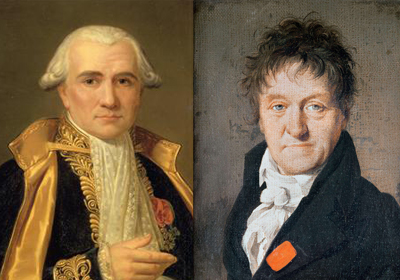
left: Gaspard Monge (1746–1818), Count of Pelusium, in his robes as president of the Senate.
right: Lazare Nicolas Marguerite Carnot (1753–1823), the Organizer of Victory.
The meaning of "duality" was later broadened to cover, in general, any situation in which two elements, two spaces or two figures play roles that are symmetric with respect to each other. Pascal's and Brianchon's theorems provide a fine example of dual theorems. Desargues's theorem, meanwhile, is self-dual: interchanging the words "point" and "line" recovers the same theorem (see the article "Two theorems for the price of one").