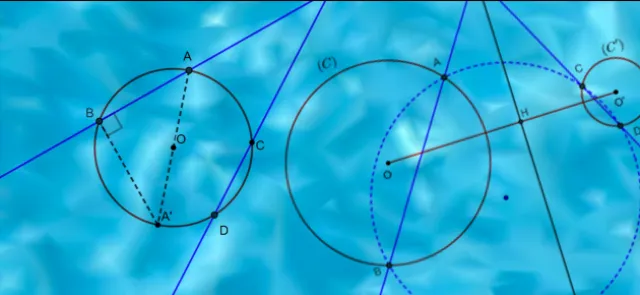
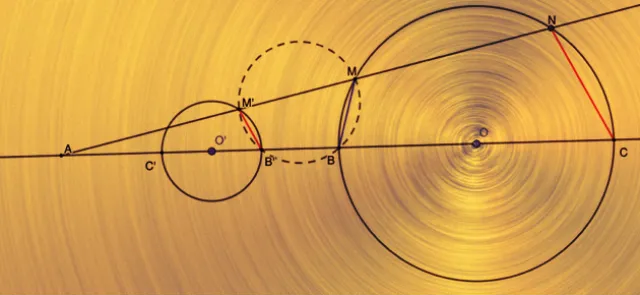
For a ray from a point O that intersects a circle (C) at points A and B, the product defines the power of the point O with respect to the circle (C). This notion can be simply defined using that of the inscribed angle and the age-old theorem of Thales. It was while studying it that Jakob Steiner discovered, only in 1824, inversion, a transformation all of whose elements had nevertheless been known since Euclid.
Inversion, the other theme
--------------------------
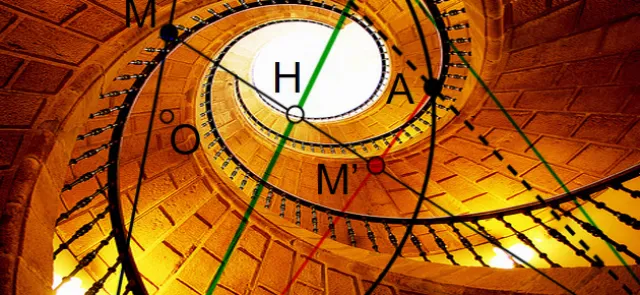
An inversion i with pole O is, like reflections, an involutive transformation, that is, such that i composed with itself is the identity. It maps every point M other than the pole O to its image, or corresponding point, M' = i(M) on the line (OM) such that where k is a given real number.
Because of the obvious analogy between this expression and that of the power of a point, the constant k is called the power of the inversion.
The circle (C) with center O and radius called the circle of inversion, is pointwise invariant and is the boundary between the interior and exterior points exchanged by the inversion. Every point N of segment [IB] will have image P = i (N) in segment [IA], and conversely N = i (P).