



FRANCOIS LAVALLOU
64 articles published in Tangente
 History and CultureN°96Dec 01, 2025
The Nine Chapters, a foundational work
The Nine Chapters on the Mathematical Procedures is a collection of problems, each chapter unified by a common procedure for solving them. Their mathematical interest lies chiefly in the commentaries and elaborations of Liu Hui, their principal commentator.
Read → History and CultureN°96Nov 28, 2025
Counting in Chinese
The Chinese numeral system dates back to the beginnings of written Chinese, around the third millennium BC.
Read → Math for everyoneN°95Aug 21, 2025
At Ratchinski's public school
For fifteen years, Sergei Ratchinski developed his own teaching method, based on creativity.
Read →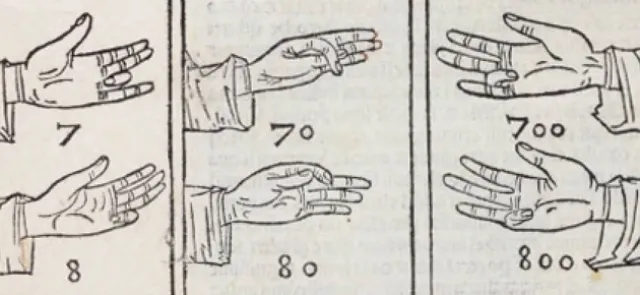 Math for everyoneN°95Aug 21, 2025
Multiplying with a deft touch
Even before they had words for numbers, human societies developed counting systems of varying sophistication to suit their activities. To count beyond a handful of units, they used the tools they always had to hand: their own bodies. The result was a range of ingenious methods for performing certain operations.
Read → Math for everyoneN°95Aug 20, 2025
Is this number prime?
Prime numbers form the backbone of arithmetic. Although their distribution remains a subject of cutting-edge research, being able to decide mentally whether a number is prime is an excellent mental exercise—both enjoyable and creative.
Read → CuriosityN°95Aug 20, 2025
Calculating prodigies
Calculating prodigies fascinate the public with their ease in rapidly performing operations on large numbers. The tricks used by these number magicians draw on abilities that are more mnemonic than mathematical, but also on numerous methods and stratagems based on various theorems.
Read →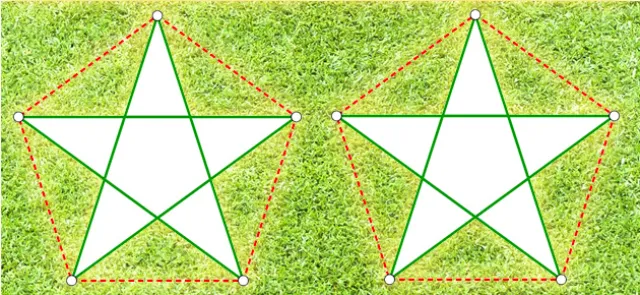 Math for everyoneN°94May 13, 2025
Order according to Ramsey
Ramsey theory is another field in which Erdős played a crucial role without being its originator. His use of the probabilistic method was essential to this theory, whose aim is to find the size of a set that guarantees the existence of a substructure possessing a given property.
Read → Math for everyoneN°92Dec 04, 2024
Squaring polygons
Archimedes' Stomachion, the world's oldest puzzle, can produce thousands of shapes from fourteen polygonal tiles. But what about the inverse problem? Under what conditions do two given polygons have a common polygonal dissection, and how can one be found?
Read → Math for everyoneN°92Dec 04, 2024
The largest small polygon
Let us consider polygons of diameter at most one—that is, polygons in which the distance between any two points is no greater than one—and determine which has the greatest area.
Read → Math for everyoneN°92Dec 03, 2024
Pythagoras and Heron
Heron's formula emerges when we seek to express the area of a triangle in terms of its side lengths. A variation of the argument recovers the Pythagorean theorem.
Read → Math for everyoneN°92Dec 03, 2024
Tangential quadrilaterals
Engineer Henri Pitot (1695–1771) is remembered for the tube that bears his name, which he proposed in 1732 to "measure the speed of flowing water and the wake of ships" and which is still widely used in aerodynamics. But geometry was this self-taught scholar's first love.
Read →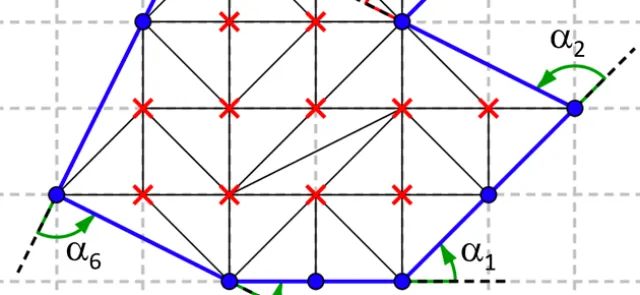 Math for everyoneN°92Dec 03, 2024
Pick's inspiring theorem
Some theorems, through the simplicity of their statements and the originality of their proofs, become enduring examples of mathematical creativity. Pick's theorem is one such example.
Read →