At the heart of Heron
---------------
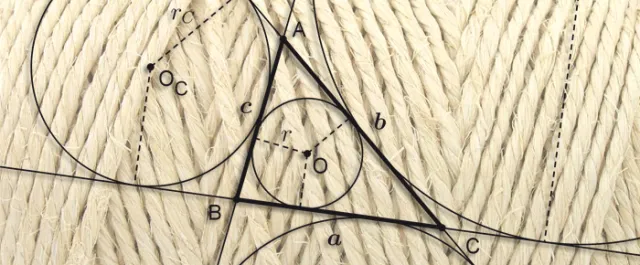
Given the lengths a, b, c of three line segments, the triangle having those segments as sides is determined up to reflection, and its area is uniquely determined.
Since the area A of the triangle is independent of how its sides are labelled, we seek to express it using a function f that is homogeneous of degree two and symmetric in the variables a, b and c, so that f (λa, λb, λc) = λ2f (a, b, c) and f (a, b, c) is independent of the order of the variables.
When the length of one side equals the sum of the lengths of the other two, the triangle is degenerate and has zero area. This condition can be written, for example, as a = b + c, or, more symmetrically, as 2a = a + b + c. Letting p = (a + b + c)/2 denote the semiperimeter, a triangle therefore has zero area when its semiperimeter equals one of its sides.
We therefore seek a symmetric function g(a, b, c), homogeneous of degree one in the side lengths, so that we can write A2 (a, b, c) = g (a, b, c)( p – a) ( p – b) ( p – c). The only possibility is g (a, b, c) = Cp, where C is a constant.