A triangle is completely determined, up to reflection, by its side lengths. But what is its area? For roughly two millennia, this question has been answered by Heron's formula, named after the Alexandrian mathematician and ingenious engineer. The area S of a triangle with side lengths a, b and c is given by , where p is the triangle's semiperimeter.
After three comes four
-----------------------
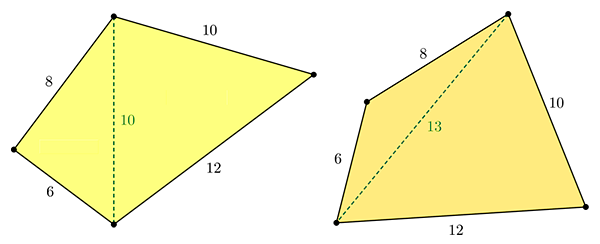
Let's now look at quadrilaterals, taking the particular case of one whose side lengths, in order, are 6, 8, 10 and 12. A quadrilateral with these side lengths is not uniquely determined, so its area is not completely determined. But specifying the length of a diagonal makes the quadrilateral rigid and thus fixes its area, which can be calculated by applying Heron's formula to the two triangles formed.