We know relatively little about the life of Heron of Alexandria—and even less about whether his head turned white or his hair ash-gray in his later years. Only by cross-referencing sources and drawing on what is known about a few of his contemporaries have historians established that our scholar probably lived in the first century, perhaps at the beginning of the second. Calculations have confirmed that he mentions a lunar eclipse that occurred in 62, while Pliny the Elder refers to one of his inventions. Probably a native of Roman Egypt, Heron was steeped in Greek and Babylonian culture. He is renowned for his broad, encyclopedic knowledge across many fields.
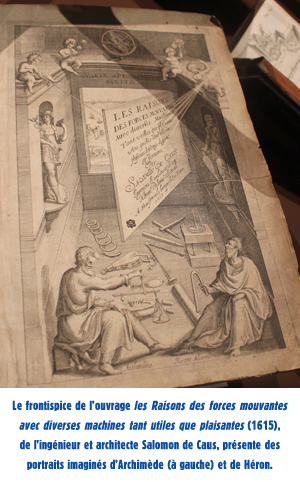
His scientific output was varied, and around ten of his treatises have survived. They cover several subjects, including measurement, both in its theoretical aspects in Metriquè and in its practical applications, with examples in Geometrica and surveying problems in Peri dioptras. He also wrote about mirrors, as well as producing several books on mechanics, machines and automata. A veritable Leonardo da Vinci of his day, Heron displayed boundless imagination in designing and building mechanisms that amazed and delighted his contemporaries. His inventions included a forerunner of the thermometer that could compare two temperatures, stage machinery for the theater, fountains and even an automatic water dispenser for libations. More surprisingly still, in Pneumatica he described an entire system that automatically opened or closed the doors of a temple when a fire was lit or extinguished on an altar! The Musée de la Magie in Paris (at 11 rue Saint-Paul and open from 2 to 7 p.m. on Wednesdays, Saturdays and Sundays) invites curious visitors to explore how this machinery works…
Heron's mathematical work
Heron's treatises were translated, retranslated, transcribed, expanded and annotated in Arabic and Latin—to such an extent that the authorship of certain passages is sometimes difficult to establish. It was not until 1896, for example, that Geometrica was (re)discovered in Constantinople. In this work, Heron gives various methods for calculating areas and volumes, accompanied by concrete practical applications for bathhouses. The treatise also contains an exceptionally efficient iterative method for approximating the square root of any number: Heron's method, which every student still learns to program today.