Until the 19th century, geometry meant what we now call Euclidean geometry, which can be defined entirely in terms of the usual notion of distance. Other geometries, described as non-Euclidean, emerged; but although they reject the fifth postulate stated by Euclid in his Elements (in the 3rd century BCE), they retain Euclidean distance. Beginning in 1906, the mathematicians Maurice Fréchet and Felix Hausdorff (see "The genesis of metric spaces") gave the notion of distance a formal structure and its own axioms. This made it possible to introduce geometric language into many questions in analysis and topology (balls and spheres, for example), and even in number theory (valuations, ultrametric distances…; see "So far, so close…").
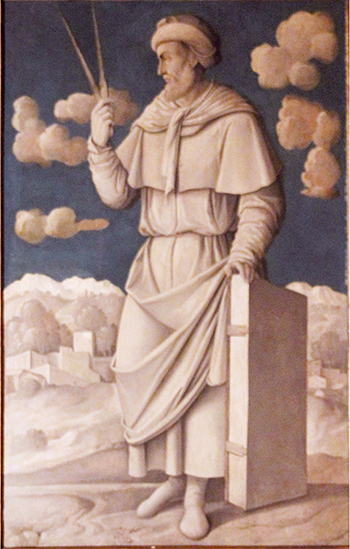
Euclid of Alexandria (c. 330 BCE, c. 275 BCE), as depicted
by the Italian Renaissance painter Girolamo Mocetto.
The Greeks, pioneers of distance
-----------------------------------