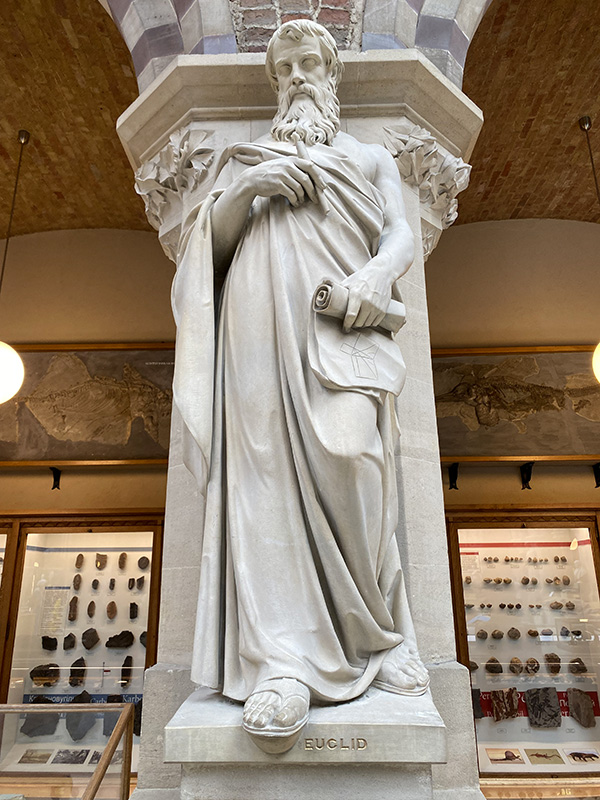
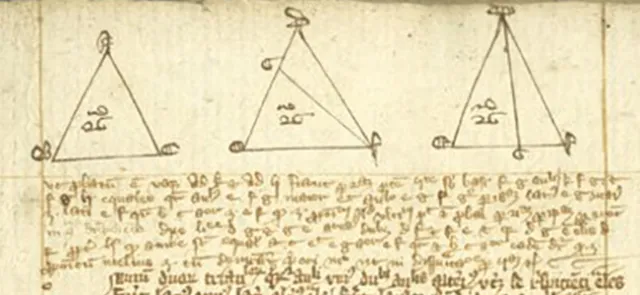
Among Euclid's works, some have not survived: one such work is the treatise On Divisions (understood as of Figures; in Greek: Περὶ διαιρἐσεων), now considered lost. Nevertheless, building on the work of the German orientalist Franz Woepcke (late 19th century), several studies have been undertaken to try to "reconstruct" the lost text from the rich textual tradition on the division of figures (transmitted in Greek, Arabic, Hebrew, and Latin). We may cite, among others, the work of the Italian Antonio Favaro (1882), the Canadian Raymond Clare Archibald (1915), and, more recently, that of Jan Pieter Hogendijk (1993), which are among the most significant.
The existence and content of this work are known to us essentially through two sources, one Greek – the testimony of Proclus (5th century) in his Commentary on Book I of the Elements of Euclid – and the other Arabic – the abridged version by Abū Sa'īd al-Sijzī (died c. 1025). The mere existence of this work is certainly known in the lands of Islam from the early 10th century onward, and then in Latin Europe from the 12th century onward. Indeed, Euclid's work on divisions is mentioned, in connection with the definition of the trapezoid, in al-Nayrīzī's Commentary [on Euclid's Elements] (Sharḥ Uqlīdis) (10th century) and in its Latin translation made by Gerard of Cremona in Toledo in the 12th century.
####