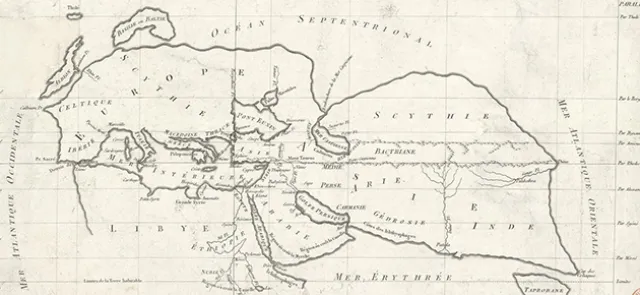
From the 8th century onwards, and for more than three hundred years, Arabic was the principal language used by authors of treatises on pure and applied mathematics. Some concepts were invented in this context, others were transmitted, and still others were reassessed and critically examined.
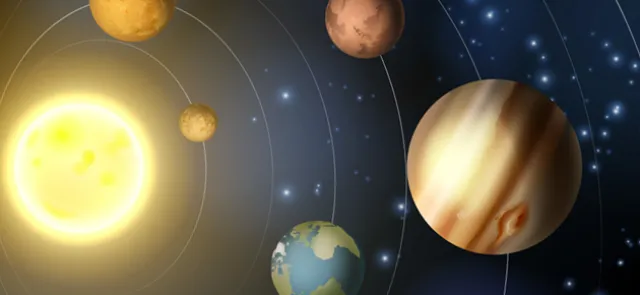
Here we shall present an example of this third case: the illuminating commentary by the Khwarazmian scholar—that is, a native of Khwarazm, on the southern shore of the Aral Sea—Abū Rayḥān al-Bīrūnī (973–1048) on a method for determining the planets' distances from Earth, from a geocentric perspective. The method had been recorded in Greek nine centuries earlier by the Alexandrian scholar Ptolemy (2nd century) in the Book of Hypotheses (the original Greek title is Ὑποθέσεων τῶν πλανωμένων, which would be more faithfully translated as "Substitutes for the Wandering Stars"). It is worth noting that al-Bīrūnī's account is so precise that it led, in the 1960s, to the discovery of the Arabic version of Ptolemy's text, which is extremely difficult to understand and whose Greek original has been lost.
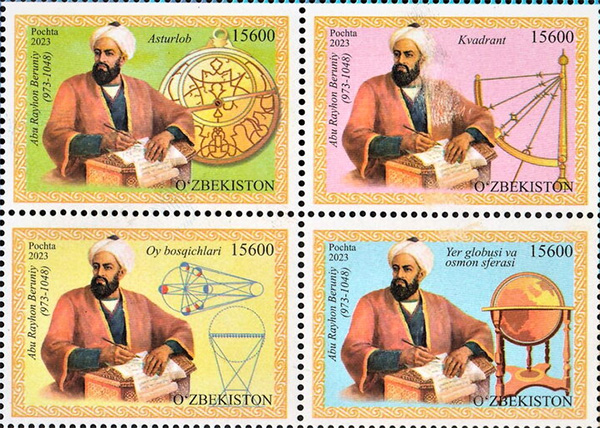
Four Uzbek stamps issued in 2023 celebrate
al-Bīrūnī's many scientific talents.