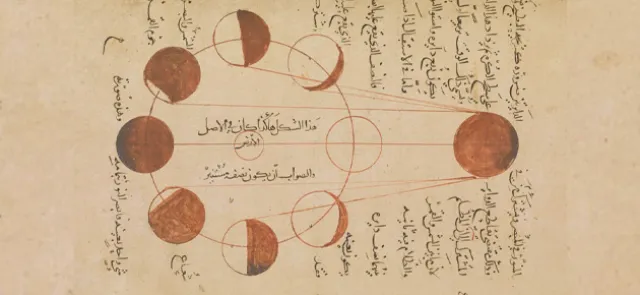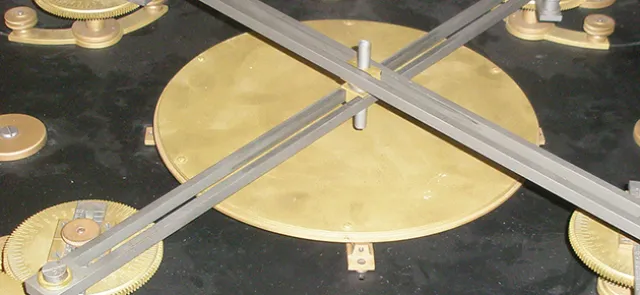
The Babylonians and Egyptians had arithmetic models that described and predicted the motions of celestial bodies across the sky fairly well. For aesthetic and philosophical reasons, the Greeks felt the need to introduce geometric models. Eudoxus of Cnidus is famous for his model of concentric spheres centered on the Earth. Polemarchus of Cyzicus, a disciple of Eudoxus, had already realized that the apparent sizes of the Sun and Moon varied. Autolycus of Pitane pointed out that no modification to the system of concentric spheres could change the planets’ distance from the Earth, since all the spheres had the same center. The alternative to spheres within spheres was spheres upon spheres.
But planetary motions could also be represented by two other, equivalent geometric constructions. One used eccentric circles, whose centers did not necessarily coincide with the Earth. The other used concentric circles surrounding the Earth, called deferents, which carried other circles called epicycles. Motion along each of these circles was uniform rotation.
Epicycles
-----------------
In the epicycle model, attributed to Apollonius of Perga, the Earth lay at the center of the celestial sphere, but the planets moved around different centers. Earlier, Heraclitus of Pontus—not to be confused with the philosopher known as Heraclitus of Ephesus—had already taught that Mercury must orbit the Sun. In the epicyclic model, for the inner planets (Mercury and Venus), the deferent represented the Sun’s orbit around the Earth, while the epicycle represented the planet’s orbit around the Sun. For the outer planets (Mars, Jupiter and Saturn, the only planets known at the time), the roles were reversed: the deferent represented the planet’s orbit around the Sun, while the epicycle represented the Sun’s orbit around the Earth.