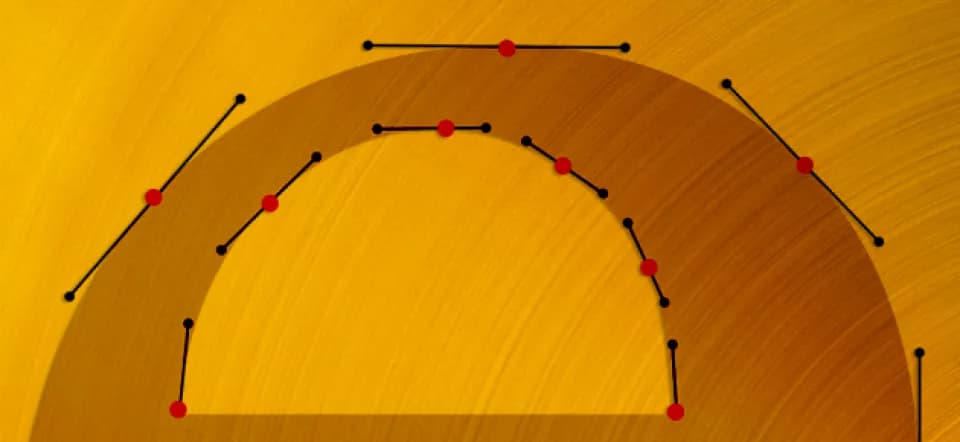
Practical problems in approximation gave rise to an industry. In the late 1950s, efforts were being made to turn the curvatures of car bodies into numbers so that computer systems could manipulate them. The solution lay in the use of Bézier curves. The industry that grew from this was vector graphics.
Before attempting to approximate the surfaces formed by car-body parts, one must first solve the simpler problem of approximating curves in the plane. Since the Weierstrass theorem states that any continuous curve can be approximated by a polynomial, a naïve approach would be to choose a degree n for our polynomial, then select n + 1 points on our curve and solve the resulting n + 1 equations in n + 1 unknowns.
Enter Bézier
-----------------
In 1962, French engineer Pierre Bézier came up with a far more geometric approach. The problem facing engineers at the time was how to transmit information from design offices to production facilities. Parts were drawn at full scale, and these enormous drawings were then sent to the workshop. Numerical data would have been easier to transmit. Another difficulty was that car bodies often involved complex curves, which could cause assembly problems unless every component was made perfectly. At a time when the first numerical-control machines were emerging, Pierre Bézier was able to put his theoretical curves to use and develop his Unisurf software, a precursor to computer-aided design software.
Let's look at a practical example.