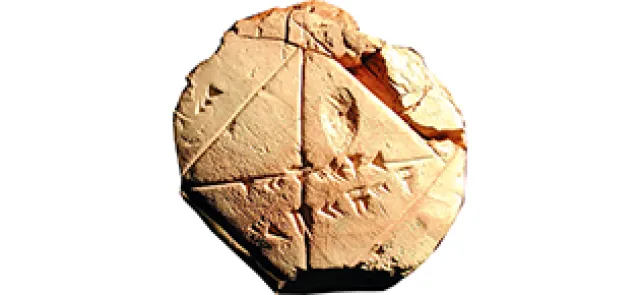
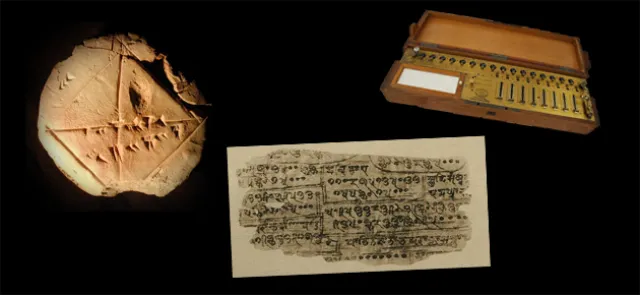
One such example is tablet YBC 7289 (that is, Yale Babylonian Collection, no. 7289), a small disk about 8 cm in diameter and 8 mm thick. It shows a square and its diagonals. On one of them (shown horizontally here), the following is written in Babylonian numerals:
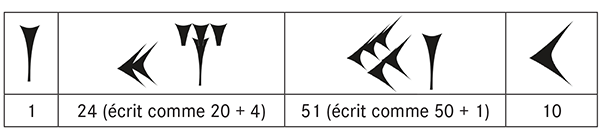
In sexagesimal notation (which also applies to fractions), this means:
This is an excellent approximation to
accurate to five decimal places!
Note that the upper-left side of the square bears the inscription

that is, 30, while beneath the diagonal is written 42 25 35, which is interpreted as
which is indeed the length of the diagonal of a square with side length 30.
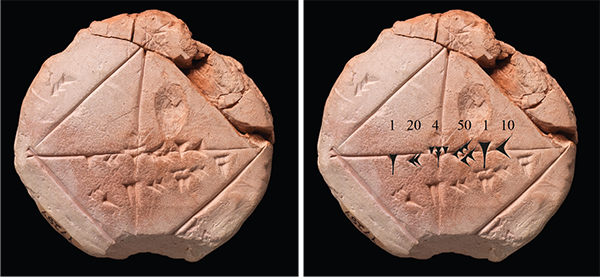
Tablet YBC 7289 as it appears (left)
and with some of the numbers highlighted (right).