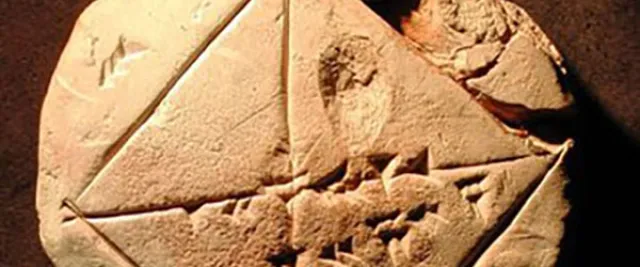
The result now known as the "Pythagorean theorem" appears, in plane geometry, in its familiar form as Proposition 47 of Book I of Euclid's Elements: in any right triangle, the square on the hypotenuse has the same area as the sum of the squares on the legs.
The next proposition (number 48) is the converse: equality between the squares implies that the triangle is right-angled. Nowhere does Euclid associate Pythagoras's name with either proposition. The text contains a general proof, illustrated by a single figure in Euclid but presented here as three diagrams. The idea is to divide the square constructed on the hypotenuse into two rectangles, each equal in area to one of the squares constructed on the sides forming the right angle.
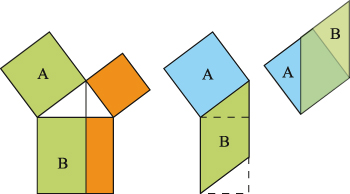
It is enough to prove that A = B, since the other equality follows by symmetry. The two transformations of region B shown on the right prove this.
=