Euclid's proof dissected
--------------------------------------
A rigorous proof of the Pythagorean theorem can take several lines. The subtle proof by Euclid (Proposition 47 of Book I) is not so difficult to follow: in the figures below, the blue, yellow, orange and pink triangles all have the same area. It follows that the blue square has the same area as the pink rectangle. Likewise, the green square has the same area as the purple rectangle, which completes the proof.
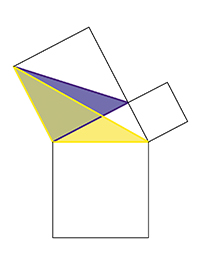
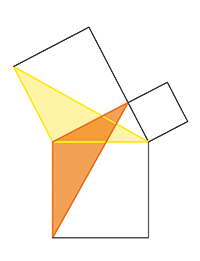
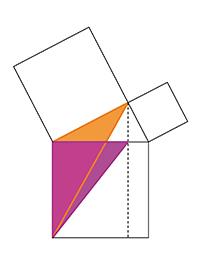
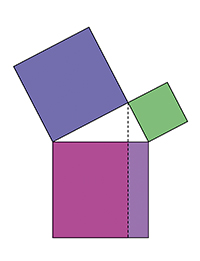
In fact, it often comes down to finding a configuration that shows that the area of a square with side length c equals the sum of the areas of two squares with side lengths a and b.
A few ingenious dissections
============================
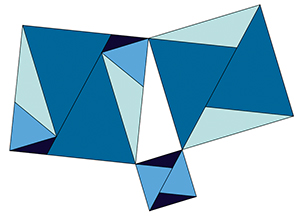
Among the many proofs of the Pythagorean theorem, some need almost no explanation. They often take the form of puzzles whose pieces are assembled in two different ways. Do you find the examples below convincing?
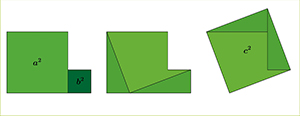
This proof could even take the form of a hinged puzzle.
Here is another classic proof without words.
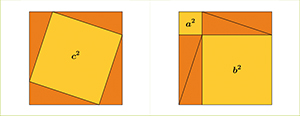
The following construction is less well known. The line divides the figure into two pentagons of equal area.
.jpg)
Finally, this last configuration is probably even harder to remember…