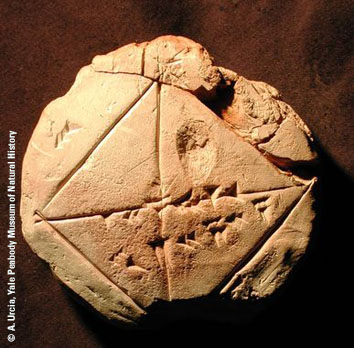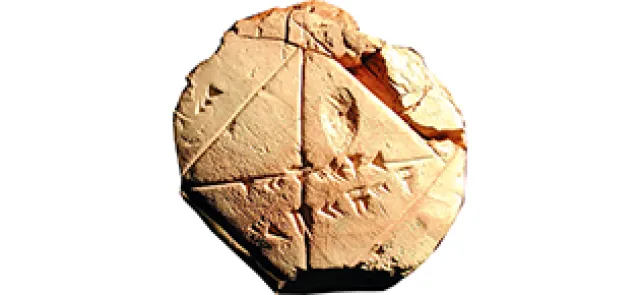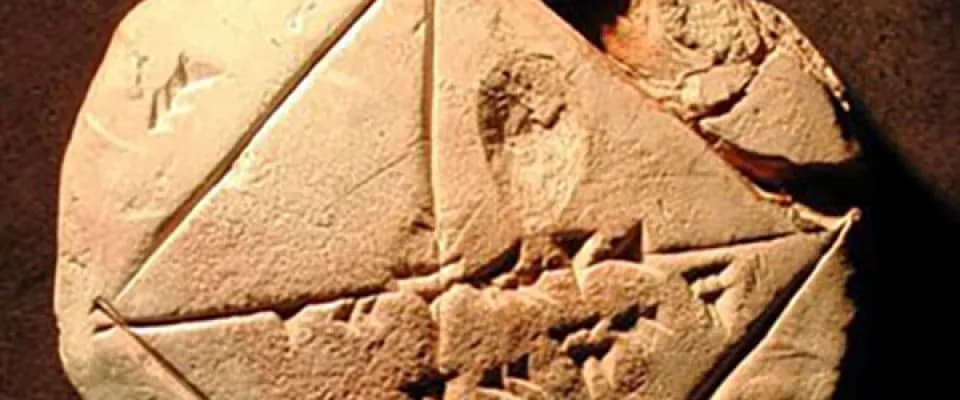
The earliest trace of Pythagoras' theorem appears in Mesopotamia four thousand years ago, in the special case of an isosceles right triangle. Much later, Plato (428–348 BCE) revisited this case in the Meno. In it, Socrates describes the following figure, which we may imagine him drawing in the sand.
By counting the triangles, we can show that the area of the tilted ochre square constructed on the triangles' hypotenuses is twice that of the small squares (one of which is shown in blue).
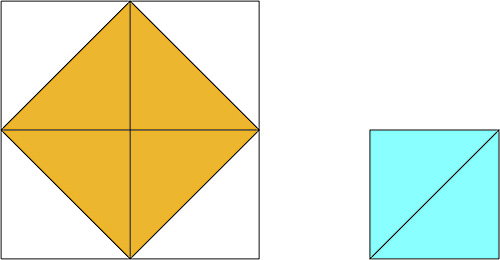
From this point, it is easy to show that the area of the large square is twice that of the tilted square. This figure carries us back and forth across more than a millennium, between Greece and Mesopotamia: between Plato and a clay tablet small enough to fit in the palm of one's hand, probably a student's exercise, according to archaeologists—one to be worked out, containing a statement and a result like the other mathematical tablets found in Mesopotamia.