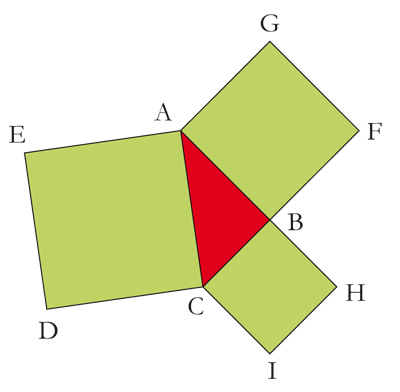
In the diagram below, ABC is the original right triangle, ACDE the square constructed on its hypotenuse, and ABFG and BCIH the squares constructed on its legs.
*
*
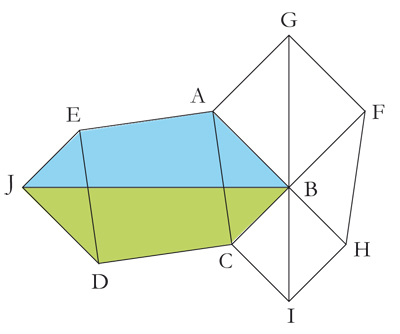
Leonardo da Vinci's original idea is to introduce two additional right triangles congruent to ABC, namely DEJ and FHB. He uses them by drawing lines BJ and IG.
*
*
The two quadrilaterals ABJE (in blue) and DJBC (in green) are congruent, since a 180° rotation makes them coincide. The sum of their areas equals the area of the square constructed on the hypotenuse plus twice the area of the right triangle.
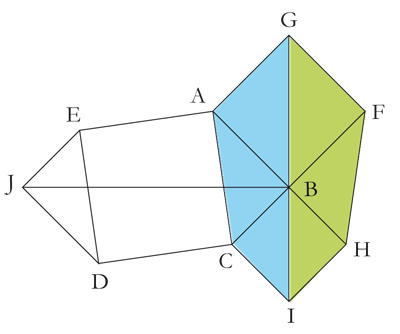
The same quadrilaterals reappear as AGIC and FGIH on the right-hand side. Here, they coincide under reflection across line IBG. The sum of their areas equals the sum of the areas of the squares constructed on the legs plus twice the area of the right triangle. It follows that the area of the square constructed on the hypotenuse equals the sum of the areas of the squares constructed on the legs—which is precisely the Pythagorean theorem.
*
*