No one will dispute it: a good diagram can very often serve as a valuable aid to proving a theorem or a property. There are even cases where the diagrams in question actually contain a certain form of proof of the property.
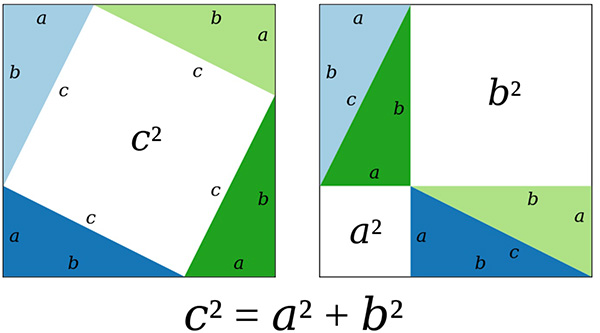
The best-known example of this kind of situation is the Pythagorean theorem, for which the pair of diagrams opposite does indeed contain what can be regarded as a proof of the result. A well-constructed diagram can also lead, without further ado, straight to the angle-sum formulas for sine and cosine.
But how far can we trust a graphical representation? To what extent can our eye be fooled — or not — by an appearance that might be deceptive?
The missing square
-----------------