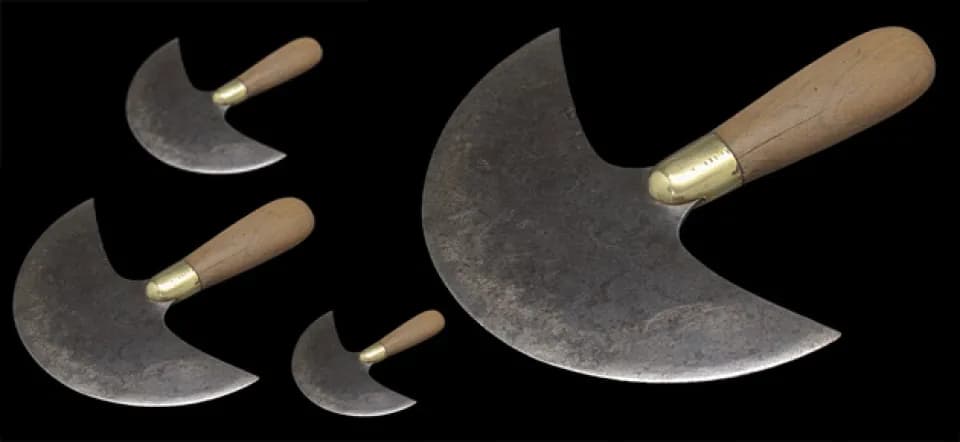
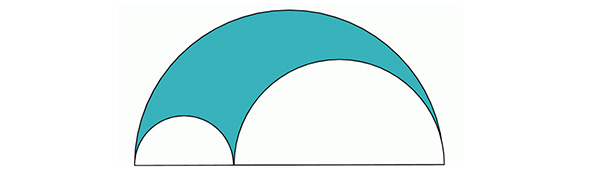
The arbelos is one of those easily recognizable mathematical shapes that have aroused the curiosity of many geometers. The Danish mathematician Jørgen Mohr (1640‒1697) helped revive its study in the 17th century with his tricircle, more recently leading to astonishing constructions such as the parbelos, the f-belos and the hyperbelos (figures similar to the arbelos, in which the semicircles are replaced in turn by arcs of a parabola, by arcs of the graph of a function f, or by arcs of a hyperbola). Let's focus here solely on the results of Archimedes, its inventor, and their development by Pappus of Alexandria (c. 290 – c. 350).
Mohr's tricircle.
The history of a shape
----------------------
As is often the case with Greek mathematical texts, everything begins with doubts. The short work in which the arbelos is described is titled The Book of Lemmas, a title indicating that it contains elegant and appealing results rather than ambitious developments. Although this book is attributed to Archimedes, its authenticity is doubtful: the results may be his, but the rather disorderly manner in which the treatise is written does not resemble the genius of Syracuse. What is more, the Greek original is lost. Fortunately, it has come down to us through the Arabic translation made by Thabit ibn Qurra in the 9th century, a man remembered for the "Thabit numbers" and to whom we also owe numerous translations (Euclid, Ptolemy, Apollonius). These translations were part of the program of the House of Wisdom in Baghdad (see Tangente 139, 2011).