



With circles
In plane geometry, the tangent, we all know it... as soon as the construction features a circle (C), a line (D) and a point P. However, there are far richer situations! With only tangent circles, an extraordinary diversity emerges. Thus the arbelos, whose vertiginous iterative construction gives rise to countless properties, each more astonishing than the others, fascinated the Ancients. Archimedes' twin circles and the chains of Pappus plunge us into the heart of one of the most elegant geometric transformations, inversion. Closer to us, Malfatti circles allow us to revisit from another angle the notion of incircle. Tangency has not finished amazing us!
All articles in this folder
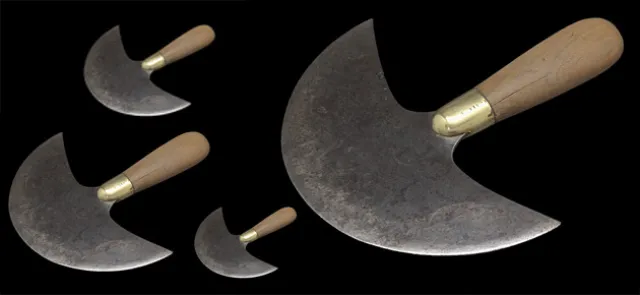
The arbelos
The properties of the arbelos, this fascinating geometric object studied since antiquity, are countless. How did the Greeks go about establishing such results? Let's look at a few clues, drawing on the texts handed down to us by Archimedes and Pappus.
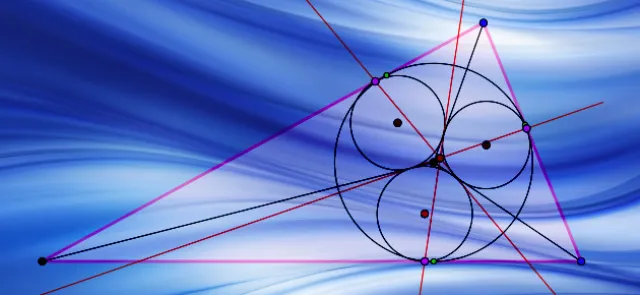
The Malfatti circles in a triangle | Tangente
In a triangle, how should three non-overlapping circles be chosen so as to minimize the area of the triangle left over once the three circles are removed? A natural solution, involving tangents within the triangle, is not the best one, but it gives rise to interesting problems.

Touching circles
Euclid's Elements, the standard reference for centuries, established straightedge-and-compass proof as the norm in geometry. But many problems involving circles tangent to one another become simpler when using conics or transformations, such as the indispensable inversion.

Beyond Descartes
Several results in the plane and in space generalize Descartes' theorem on the curvatures of tangent circles.

Constructing tangents
If we know how to carry out the classic straightedge-and-compass constructions, we are perhaps less at ease drawing the common tangents to two circles. Now is the time to put our whole range of knowledge of Euclidean geometry into practice!