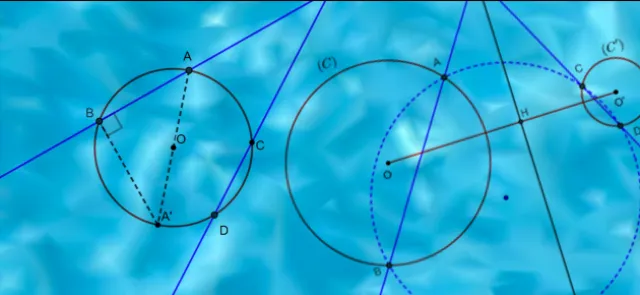
We already know how to construct the tangents to a circle (C) with center O that pass through a given point A obviously outside (C): it suffices to draw the circle with diameter [OA], then join A to the two points of intersection of the two circles.
We also know how to construct the tangents to (C) parallel to a given line d: we construct the perpendicular to d through O, which meets (C) at T and T′, then the parallels to d through T and T′.
But how do we construct the tangents common to two circles?
Common external tangents…
-------------------------------
Let's consider the (simple) case of constructing the common external tangents (that is, tangents for which the circles lie "on the same side" of the tangent line) to two red circles (C) and (C′) with respective centers O and O′, with radii r and r’. It is clear that if one circle lies strictly inside the other, they have no common tangent. So let's take the opposite case and reason, as in any construction problem, by analysis and synthesis.