What should you do when faced with a construction problem? Common sense suggests beginning with a freehand sketch of the desired figure, then examining the resulting drawing for geometric features of its elements that will provide a construction procedure. The final step is to verify the resulting construction.
Analysis and synthesis
-------------------
Over the centuries, geometers codified this approach and gave it a name: analysis and synthesis. It applies to every branch of mathematics, but we shall consider it here in the context of geometry. Let the French mathematician François Viète (1540–1603), who transformed algebra in his day (see Tangente 194, 2020), describe its historical development in his Isagoge in artem analyticem: "In mathematics there is a method for seeking the truth that Plato is said to have invented, and that Theon named analysis and defined as follows: regard the object sought as though it were given, and proceed from consequence to consequence until the object sought is recognized as true. Synthesis, by contrast, is defined as follows: begin with something given and proceed from consequence to consequence until the object sought is found."
The German philosopher Immanuel Kant (1724–1804) said much the same when he described analysis as a "regressive" method and synthesis as a "progressive" one.
Solving a geometric construction problem therefore involves two stages:
• First stage: analysis. We assume that the problem has been solved—exactly as we did when drawing the freehand sketch—and examine the construction as though it were "the" solution, even though it is only approximate. The mathematician and mathematics-education specialist Georges Glaeser (1918–2002) called this "identifying the essential concepts and distinguishing what we already know from what we would like to know". We try to see how the geometric elements to be constructed are related to those already given, and how they are related to one another. We may seek to reduce the problem to finding key points whose positions will allow us to complete the required figure. These may be identified as intersections of lines, circles, curves, and so on, or we may recognize in them properties that will help us complete the figure.
This analysis ultimately enables us to identify the necessary conditions for carrying out the final construction.
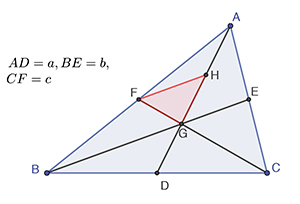
A triangle whose median lengths alone are known.
For example, suppose we are asked to reconstruct a triangle from the known lengths a, b, c of its three medians. Assuming the problem has been solved, we can observe that if H is the midpoint of segment AG, triangle FGH has side lengths one-third those of the triangle ABC that we wish to construct. We shall exploit this feature to complete the construction of triangle ABC: starting from segment AD, of length A, with G one-third of the way from D along this segment, we can draw triangle FGH with side lengths a / 3, b / 3 and c / 3, which will allow us to position C and B correctly. Here, point H is the key to the rest of the construction.
• Second stage: synthesis. This is, in a sense, the "converse" of the preceding stage. First, guided by the information obtained through analysis, we carry out the required construction, justifying each step in turn. We then determine any limitations or cases in which the construction is impossible. This may lead to the questions: are there cases in which the construction cannot be carried out? Can there be several solutions?
Putting the method into practice
----------------
Suppose, for example, that we are asked to construct a circle tangent to a given line d and passing through two given points A and B. If A and B lie on opposite sides of d, there is no solution. Synthesis also leads us to consider the number of solutions in the other cases: if A lies on d and B lies off it, there is a single solution—the circle whose center is the intersection of the line perpendicular to d at A and the perpendicular bisector of segment AB. If line AB is parallel to d, there is again a unique solution, with the point of tangency, as before, at the intersection of d and the perpendicular bisector of segment AB. In every other case, there are two circles satisfying the conditions, which can be found by first constructing their points of tangency with d.
Although the method of analysis and synthesis applies to many branches of mathematics, it is particularly well suited to construction problems.
The inscribed square
----------------
Many classic constructions illustrate the method of analysis and synthesis. One is to "inscribe a square in a triangle": given any triangle ABC, we must construct a square with, for example, two vertices on side [BC], one of the other two on [AB], and the other on [AC].
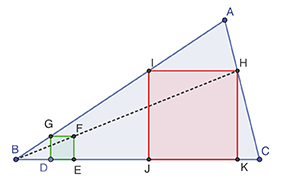
Let us analyze the problem. We know how to construct a "small" square (in green) with two vertices, D and E, on [BC] and a third, G, on [AB], although the fourth, F, does not lie a priori on [AC]. No matter: a dilation h with center B will take it there—namely, the dilation that maps F to a point H on [AC]. Under h, line AB, which passes through the center of the dilation, maps to itself, while line GK maps to the line parallel to it through H. These two images intersect at I on [AB]. And there is the side of our square!
Now comes the synthesis. Starting from the intermediate square DEFG, the result of our analysis gives us segment IH, where H lies on [AC] and is the image of F under the dilation h with center B. Point I is then the image of G under the same dilation. We also construct the two points on side BC: J, the image of D, and K, the image of E. Since quadrilateral IJKL is the image of a square under a dilation, it too must be a square.
A question now arises: is such a construction always possible?
The answer is "yes" when ABC is an acute triangle. If one of its angles is obtuse—at B, for example—we choose a dilation h with center C (where the angle is necessarily acute), and the vertices of square IJKL lie not on the line segments forming the sides, but on the lines extending them.