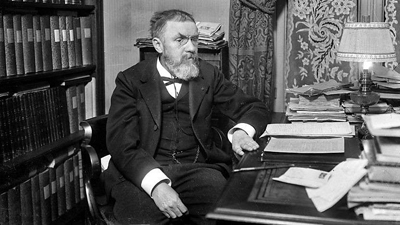
"The scientist must impose order, science is built from facts as a house is built from stones, but a collection of facts is no more a science than a heap of stones is a house", wrote the mathematician Henri Poincaré in 1905 in his landmark work, La Valeur de la science (Flammarion). More than a century later, his observation has lost none of its force: mathematical reasoning remains as relevant as ever and is the very foundation of the science we hold dear. It is also what gives mathematics its richness, allowing us constantly to discover new properties, devise new theorems and prove new results. The potential and power of mathematical reasoning lie chiefly in its many forms: the same line of reasoning can be adapted to very different subjects, while the same topic can be approached through several distinct forms of reasoning. Let's look at the most widely used and universal forms.
Reasoning in the shadows
----------------------------
So it all begins with stones. Stones? They are our ideas, the ideas that will give rise to a hypothesis and then take us from the particular to the general. There is no "reasoning" here in the strict sense, but rather an underlying process: reasoning in the shadows—an intuition, the first stone in the building. It will form the basis of an informal kind of reasoning: induction, which allows us to formulate a conjecture from several consistent examples. That conjecture can then be proved… or disproved by a counterexample. Suppose, for instance, that we seek all points P from which a given line segment [AB] subtends a right angle. After constructing a few such points, we may suspect that they lie on a circle with diameter [AB]… though this must, of course, still be proved (see Les Angles, Bibliothèque Tangente 53, 2015). We have thus "suspected" the truth without engaging in any formal reasoning.
One particular form of inductive reasoning—another kind of "reasoning in the shadows"—is reasoning by analogy. Analogy, the source of some dazzling intuitions, allows us to anticipate certain mathematical facts that only reasoning can turn into truths.