The young mathematician Terence Tao, born in 1975, was described by our colleague Jean-Paul Delahaye in his "Logic and computation" column ( Pour La Science 390, April 2010) as "a friendly, modest mathematician who enjoys working with his colleagues. He is interested in teaching and in bringing mathematics to audiences of all kinds; he is curious and pursues research in several fields at once […]. Many researchers regard Tao as the greatest living mathematical genius".
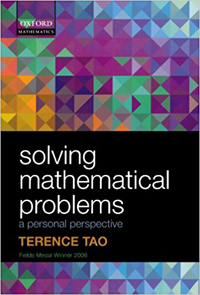
Tao wrote an excellent book entitled Solving Mathematical Problems: A Personal Perspective (Oxford University Press; the latest edition, published in 2006, is now almost out of print). The manuscript for the first edition was written when Tao was 15—and had already won several medals at the International Mathematical Olympiad!
The first chapter explores strategies for tackling an unfamiliar problem. Explicitly inspired by those presented in George Polya's classic book How to Solve It (Dunod, 1965), these strategies are illustrated through a highly accessible problem that Tao works through in nine stages. It is instructive to discover the many avenues he considers, then see how each is either pursued and developed or rejected.
In the following chapters, Tao applies the same methodology to examples drawn successively from number theory, algebra and analysis, Euclidean geometry, analytic geometry, and a range of miscellaneous problems. Most of these problems were set at mathematical olympiads.