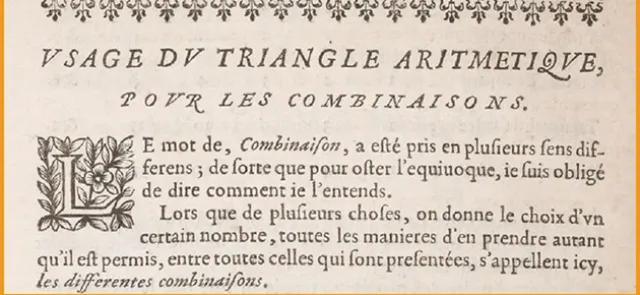
The Traité du Triangle Arithmétique et traités connexes, an initial version of which exists in Latin, was written by Pascal in 1654 and published in 1665. We know that this "arithmetic triangle" had been represented in one form or another long before Pascal, and that its history is particularly rich and fascinating (see Tangente 176). Pascal is known as a thinker, physicist, polemicist, apologist and, of course, mathematician, but he is now also regarded as a philosopher capable of distinguishing scientific knowledge from revelation: a rationalist in the former case, he studied texts (the Bible, Saint Augustine…) in the latter. His approach combined observation, induction, deduction and the communication of his discoveries with remarkable artistry. Pascal thus sought to be both a scholar and a writer who would be read and understood by educated people.
The search for truth
--------------------
Pascal was committed to conveying the truth: "There can be three principal aims in the search for truth: (1) to discover it when seeking it; (2) to prove it once it has been found; (3) to distinguish it from falsehood when examining it. I shall not discuss the first: I shall deal chiefly with the second, which encompasses the third."
The Treatise is primarily concerned with the first two aims: truth must be discovered by examining the arithmetic triangle—in other words, by conjecturing true relations; this is a matter of mathematical research. The second step is to prove them by constructing a convincing, rigorous argument. Aim (3) also comes into play in connection with aim (1), since researchers will often "test" assumptions, particularly by looking for possible counterexamples that prove certain conjectures false.
Before delving further into the text, let's borrow the following notation from the mathematician Pierre Humbert (1891–1953): (r, p) will denote the number in the cell at the intersection of horizontal (parallel) row r and vertical (perpendicular) row p. Thus, (5, 3) = 15 and (3, 7) = 28. In this notation, the rule for constructing the triangle is: (r, p) = (r – 1, p) + (r, p – 1). Pascal writes: "The number in each cell is equal to the number in the preceding cell of its perpendicular row, plus that in the preceding cell of its parallel row. Thus cell F—that is, the number in cell F—is equal to cell C plus cell E, and likewise for the others."